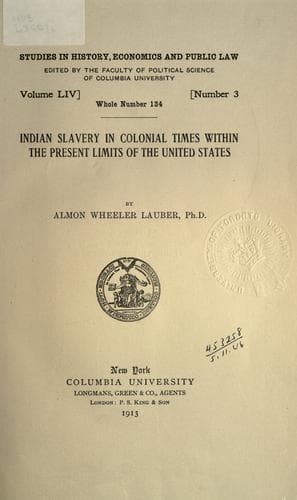
Indian slavery in colonial times within the present limits of the United StatesLauber, Almon Wheeler
History
Indian slavery in colonial times within the present limits of the United States
Lauber, Almon Wheeler
Indians of North America; Indians, Treatment of -- United States; Slavery -- United States; Thesis (Ph. D.)
[744] Wheeler, _op. cit._, p. 15. Had there been any objection raised
by the mother country to the enslavement of Indians on the ground of
illegality, the colonists could have fallen back on the recognized
right of enslaving captives in war. By a legal fiction the Indians
could at any time have been considered in a state of war, their lands
confiscated and their persons seized and held for disposal at the
pleasure of the whites. Such was the legal argument used by England in
justification of enslaving the African negroes.
[745] For a discussion of the neglect to define the Indians’ rights in
the various letters patent and charters, see the _Eighteenth Annual
Report of the Bureau of American Ethnology_, pt. ii, p. 550.
[746] _Massachusetts Historical Society Collections_, series 3, i, p.
27, contains a bill of sale of an Indian man, given by Governor John
Winthrop of Massachusetts to John Mainford of Barbadoes.
[747] As typical examples of this kind of advertisement, see _Boston
Gazette_, December 15, 1718; _Pennsylvania Gazette_, March 7, 1732;
_New England Weekly Journal_, March 5, 1733; _Boston News Letter_,
August 20, 1711; January 5, 1719; December 28, 1720.
[748] _Boston News Letter_, July 2, 1711; October 11, 1708; October
6, 1737; February 11, 1717; November 22, 1708; May 24, 1714; _Boston
Gazette or Weekly Journal_, November 15, 1748; _New England Weekly
Journal_, February 24, 1729.
[749] Stiles, _A History of the City of Brooklyn_, etc., i, p. 233;
_New York Mercury_, June 12, 1758.
[750] _Early Records of Portsmouth_, p. 434; Currier, _History of
Newbury_, p. 254.
[751] Winthrop, _Life and Letters of John Winthrop_, ii, p. 252;
Winsor, _The Memorial History of Boston_, i, p. 489.
[752] See _South Carolina Historical and Genealogical Magazine_, vii,
p. 169, (1691); x, p. 85, (1694); v, p. 98, (1710); v, p. 164, (1730);
vi, p. 173, (1732); v, p. 105, (1734); vi, p. 117, (1735); v, p. 218,
(1753); v, p. 113, (1765); viii, p. 214, (1769); vi, p. 25, (1802).
[753] _Charleston Year Book_, 1900, p. 42 (appendix), cites a will in
New London, Connecticut (1711) disposing of Indian slaves. Schuyler,
_Colonial New York_, ii, p. 293, cites the will of Arient Schuyler,
December, 1724, bequeathing to each of his two daughters an Indian
slave woman. February 7, 1690, South Carolina passed a law that slaves
should descend by inheritance like any other property. _The Statutes at
Large of South Carolina_, vii, p. 343.
[754] See Weeden, _Economic History of New England_, i, p. 292.
[755] See _Early Records of Providence, Rhode Island_, xvi, p. 244.
[756] _The Statutes at Large of South Carolina_, vii, p. 343.
[757] Bacon, _Laws of Maryland_, etc. Both these laws related to slaves
in general, and did not specify either negro or Indian slaves.
[758] Mason, _A Brief History of the Pequot War_, etc., in Orr, _op.
cit._, p. 39.
[759] Mayhew, _op. cit._, p. 26.
[760] Coffin, _A Sketch of the History of Newbury_, etc., p. 153.
Public-domain text, read in full here on John Shaqi.
Reviews
Reviews
No reviews yet
Be the first to share your thoughts on this work.
Elsewhere in the archive
Join the Discussion
Join the discussion
Sign in to leave a comment or review.
Sign InorCreate an account