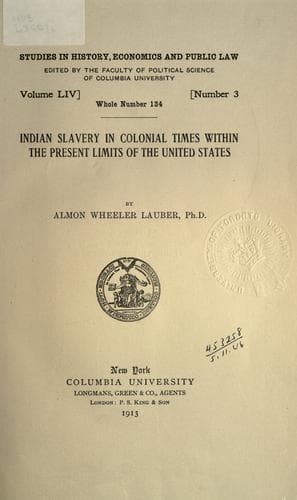
Indian slavery in colonial times within the present limits of the United StatesLauber, Almon Wheeler
History
Indian slavery in colonial times within the present limits of the United States
Lauber, Almon Wheeler
Indians of North America; Indians, Treatment of -- United States; Slavery -- United States; Thesis (Ph. D.)
[733] Moore, in _Historical Magazine_, x, p. 189. The Reverend John
Davenport, in a letter to the younger Winthrop, June, 1666, spoke of
the baptism of slaves “born in the house.” _Historical Magazine_, x,
p. 59. The instance of Mr. Maverick of Noddle’s Island attempting to
breed slaves is another example of the general custom of the time of
holding the children of slave women as slaves. Littleton _v._ Tuttle,
in _Massachusetts Reports_, iv, p. 128; Cushing, _Reports_, x, p. 410.
Felt, in _Statistical Association Collections_, i, p. 586. Palfrey,
_History of New England_, ii, p. 30, states that no person was ever
born into legal slavery in Massachusetts. See also Moore, _Notes on
the History of Slavery in Massachusetts_, pp. 24–25, and Steiner, _op.
cit._, pp. 18–19.
[734] Pirate _v._ Dalby, 1786 (Pennsylvania), in 1 _Dallas_, second
edition, p. 167; Wilson et al. _v._ Hinkley et al., 1787 (Connecticut),
in _Kirby_, p. 202; The State _v._ Van Waggoner, 1797 (New Jersey),
in 1 _Halstead_, p. 374; Jenkins _v._ Tom, 1792 (Virginia), in 1
_Washington_, p. 123; Coleman _v._ Dick, 1793 (Virginia), in 1
_Washington_, p. 233; Hudgins _v._ Wright, 1806 (Virginia), in 1
_Hening and Munford_, second edition, p. 134; Pallas et al. _v._ Hill
et al., 1807 (Virginia), in 2 _Hening and Munford_, second edition, p.
149; Gregory _v._ Baugh, 1831 (Virginia), in 2 _Leigh_, p. 665.
[735] Wheeler, _op. cit._, p. 20; 2 _Leigh_, p. 665.
[736] Ballagh, _op. cit._, p. 31.
[737] _Ibid._, pp. 31–32.
[738] Hurd, _The Law of Freedom and Bondage in the United States_,
i, pp. 249, 257, 260, 262, 265, 266, 268, 269, 275, 276, 283, 288,
295–297, 310; Ballagh, _op. cit._, p. 35.
[739] Ballagh, _op. cit._, p. 35. Indian slavery in Virginia was not,
then, actually in existence until so decreed by the laws of 1670, 1676
and 1682. Hening, _op. cit._, ii, pp. 280, 283, 346, 404.
[740] Ballagh, _op. cit._, pp. 27–37. The status of servitude had
distinct recognition in statute law as follows: Virginia, 1619;
Massachusetts, 1630–1636; Maryland, 1637; Connecticut, 1643; Rhode
Island, 1647; North Carolina, 1665; Pennsylvania, 1682; Georgia, 1732.
Ballagh, _op. cit._, p. 36.
[741] Bartram, _Retrographs_, p. 42.
[742] _The Statutes at Large of South Carolina_, vii, p. 352. The act
was repeated in 1722. _Ibid._, vii, p. 371.
[743] Hurd, _op. cit._, i, p. 225. Not until 1772 did the highest
English court declare the common law of England incompatible with
slavery, and neither recognizing nor permitting its existence in
England. The decision had no relation to the colonies.
Public-domain text, read in full here on John Shaqi.
Reviews
Reviews
No reviews yet
Be the first to share your thoughts on this work.
Elsewhere in the archive
Join the Discussion
Join the discussion
Sign in to leave a comment or review.
Sign InorCreate an account