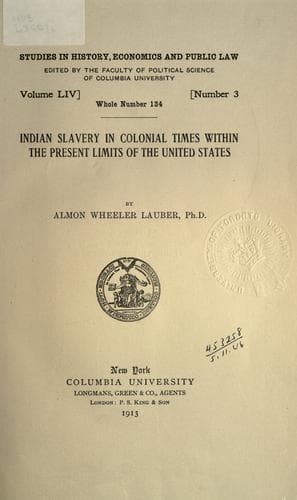
Indian slavery in colonial times within the present limits of the United StatesLauber, Almon Wheeler
History
Indian slavery in colonial times within the present limits of the United States
Lauber, Almon Wheeler
Indians of North America; Indians, Treatment of -- United States; Slavery -- United States; Thesis (Ph. D.)
[972] Martin, _The Public Acts of the General Assembly of North
Carolina_, 1715–1803, i, p. 50.
[973] Nevill, _op. cit._, i, p. 19.
[974] Allinson, _op. cit._, p. 308. By the terms of the act, the court
could, if it thought best, inflict punishment other than death for some
of these crimes.
[975] Winthrop, _Journal_, in _Original Narratives of Early American
History_, i, p. 226.
[976] _New England Courant_, June 17, 1723; _Pennsylvania Gazette_,
October 12, 1738; _American Weekly Mercury_, August 28, 1729, and
August 6, 1730; _New England Weekly Journal_, December 2, 1728. These
marks may, in some instances, have been tattooed for decorative
purposes. The South Carolina acts of 1712 decreed branding as
punishment for specified crimes committed by “slaves.” _The Statutes at
Large of South Carolina_, vii, pp. 359–360, 374, 376, 377.
[977] Martin, _The Public Acts of the General Assembly of North
Carolina_, 1715–1803, i, p. 50.
[978] _The Statutes at Large of Pennsylvania_, iii, p. 254.
[979] _Ibid._, v, p. 109.
[980] Nevill, _op. cit._, i, p. 22.
[981] _Minutes of the Common Council of the City of New York_, i, p. 92.
[982] _Ibid._, i, p. 134.
[983] _Ibid._, iii, p. 30.
[984] _Ibid._, iv, p. 50. The whipping was to be given, if desired, by
the master or owner of the slave.
[985] _Ibid._, iii, p. 177.
[986] _Ibid._, iv, p. 87.
[987] _Ibid._, iv, p. 88.
[988] _Minutes of the Common Council of the City of New York_, iv, p.
89.
[989] _Ibid._, vi, p. 157.
[990] _Ibid._, vi, p. 177. The city ordinances were usually continued
one year and were then renewed. In this way the ordinances mentioned
were in many cases continued into the Revolutionary period. The
records of the early eighteenth century show the frequent punishment
of “slaves, negroes and Indians” for being out too late at night,
collecting in too large groups, noisy reveling and gambling. On such
occasion the owner of the slaves was fined. Watson, _Annals and
Occurrences of New York City and State_, etc., p 162.
[991] _Acts and Laws of Connecticut_, edition of 1750, p. 240.
[992] _Ibid._, p. 230.
[993] _Acts and Resolves_, i, p. 156.
[994] _The Medford Historical Register_, iii, 1900, No. 3, p. 121. The
master also was to be fined for his negligence.
[995] Livermore, _A History of Block Island from its Discovery_, etc.,
p. 61.
[996] The South Carolina act of 1690 provided various sorts of
mutilation for any slave convicted of specified crimes. _The Statutes
at Large of South Carolina_, vii, pp. 359–360.
[997] Martin, _The Public Acts of the General Assembly of North
Carolina_, 1715–1803, i, p. 50.
[998] _Massachusetts Historical Society Proceedings_, series 2, xiii,
p. 252.
[999] _Laws of New Hampshire_, edition of 1904, i, p. 117.
[1000] Weise, _The History of the City of Albany_, p. 209.
[1001] _New York Colonial Manuscripts, Instructions_, etc., 1660,
quoted in Baird, _History of Rye_, p. 185.
Public-domain text, read in full here on John Shaqi.
Reviews
Reviews
No reviews yet
Be the first to share your thoughts on this work.
Elsewhere in the archive
Join the Discussion
Join the discussion
Sign in to leave a comment or review.
Sign InorCreate an account