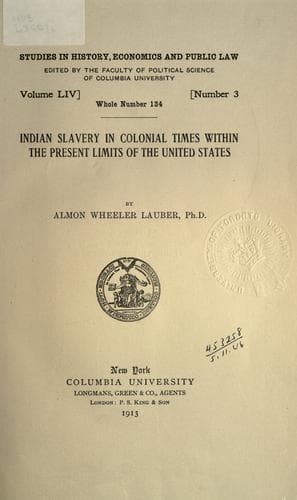
Indian slavery in colonial times within the present limits of the United StatesLauber, Almon Wheeler
History
Indian slavery in colonial times within the present limits of the United States
Lauber, Almon Wheeler
Indians of North America; Indians, Treatment of -- United States; Slavery -- United States; Thesis (Ph. D.)
[960] _The Statutes at Large of South Carolina_, vii, p. 369. By this
act nothing was awarded the owner if the slave was executed for murder.
[961] Bacon, _Laws of Maryland_. Other Maryland acts of 1737, 1740,
1744, 1747, 1751, 1754, 1757, and 1762, required that the full adjudged
value be paid the owner of any slave executed by law. Bacon, _op. cit._
[962] Massachusetts, 1703, _Acts and Resolves_, i, p 535; Rhode Island,
1704, _Rhode Island Historical Society Collections_, vii, p. 230; 1750,
_Records of Rhode Island and Providence Plantations_, v, p. 320; and
1770. _Rhode Island Laws_, edition of 1772, pp. 24, 25; Block Island,
1709, Livermore, _A History of Block Island from its Discovery_, etc.,
p. 61; New Hampshire, 1714, _Laws of New Hampshire_, edition of 1771,
p. 52. Connecticut, in 1750, forbade Indian slaves being abroad after
nine o’clock at night without the owner’s permission. _Acts and Laws
of Connecticut_, edition of 1750, p. 230. New York City, in 1713,
stated the latest time at which Indian slaves could be away from home
without their masters’ permission as one hour after sunset. _Minutes
of the Common Council of the City of New York_, iii, p. 177; and 1751,
_Ibid._, iv, p. 87. Rhode Island, 1667, forbade any Indian to walk
about in the night time. Livermore, _op cit._, 61. New Jersey, 1713,
forbade any negro, Indian or mulatto slave to go five miles from home
without his master’s permission. Nevill, _op. cit._, i, p. 21.
[963] Massachusetts, during King Philip’s War, Baylies, _op. cit._,
pt. iii, p. 189; Block Island, 1675, Livermore, _op. cit._, p. 60;
New Hampshire, 1689, _Laws of New Hampshire_, edition of 1904. i, p.
288 (The act referred simply to Indians without specifying bond or
free); the city of Albany, 1686, Munsell, _Annals of Albany_, viii,
296; New York City, 1683, _Minutes of the Common Council of the City
of New York_, i, 134; Pennsylvania, 1721, _The Statutes at Large of
Pennsylvania_, iii, p. 254.
[964] Massachusetts, 1693, _Acts and Resolves_, i, p. 156; New York,
1715, _New York Colonial Laws_, edition of 1894, i, pp. 157, 519; New
Jersey, 1682 and 1713, Leaming and Spicer, _Grants and Concessions_, p.
254; Nevill, _op. cit._, i, p. 18.
[965] Winsor, _The Memorial History of Boston_, ii, p. 485.
[966] Moore, _Notes on the History of Slavery in Massachusetts_, p. 191.
[967] _Connecticut Colonial Records_, i, p. 349; Stiles, _The History
and Genealogies of Ancient Winsor_, i, p. 434.
[968] Watson, _Annals and Occurrences of New York City and State_, p.
158.
[969] Weise, _The History of the City of Albany_, p. 209.
[970] Dunlap, _History of the New Netherlands_, etc., ii, appendix, p.
clxiii.
[971] The slave code of South Carolina was more elaborate than that of
any other colony. But the various laws relating to trial and punishment
of slaves make no mention of Indian slaves, though as has been seen,
Indian slaves were more numerous in that colony than elsewhere.
Public-domain text, read in full here on John Shaqi.
Reviews
Reviews
No reviews yet
Be the first to share your thoughts on this work.
Elsewhere in the archive
Join the Discussion
Join the discussion
Sign in to leave a comment or review.
Sign InorCreate an account