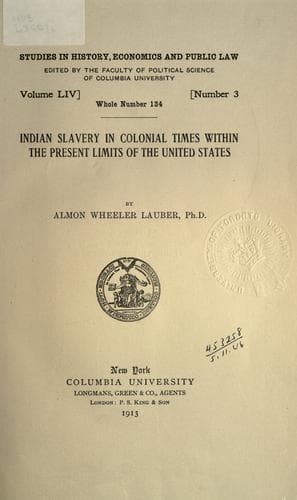
Indian slavery in colonial times within the present limits of the United StatesLauber, Almon Wheeler
History
Indian slavery in colonial times within the present limits of the United States
Lauber, Almon Wheeler
Indians of North America; Indians, Treatment of -- United States; Slavery -- United States; Thesis (Ph. D.)
[1060] Ewell, _The Story of Byfield_, p. 88.
[1061] Perry, _Historical Collections relating to the American
Episcopal Church_, ii, p. 231.
[1062] _Journal of the American Irish Historical Society_, iii, p. 57.
[1063] Johnston, _Slavery in Rhode Island_, in _Rhode Island Historical
Society Publications_, 1894, ii, p. 120.
[1064] Hurd, _op. cit._, i, p. 272; Steiner, _op. cit._, p. 16, in
_Johns Hopkins University Studies_, xvi.
[1065] Cobb, _An Historical Sketch of Slavery from the Earliest
Periods_, p. clii.
[1066] Coffin, _History of Newbury_, p. 336, cites instances in Newbury
in 1687 and 1702. Orcutt, _The History of the old Town of Derby,
Connecticut_, p. lvii, mentions a deed of manumission in Connecticut
in 1688, given to Tobie, an Indian captive of King Philip’s War.
Smith, _History of Delaware County, Pennsylvania_, p. 219, refers to
the conditional manumission of an Indian slave, three years old, born
in the family. Cotton Mather, also, promised to free an Indian slave
at the close of four years of service. _Diary_, in _Massachusetts
Historical Society Collections_, series 7, vii, p. 203.
[1067] A Virginia act of 1782 provided for the freeing of a slave
by an instrument in writing submitted by the owner. A copy of this
instrument attested by the clerk of the county court was to be given to
the manumitted slave. Any master neglecting to give such a copy to the
slave in question was liable to a fine of £10. Hening, _op. cit._, xi,
p. 39. Maryland by an act of 1752 declared that owners under ordinary
circumstances had the right to free slaves. Two witnesses were required
for the act, which must be in writing. Bacon, _Laws of Maryland_. These
acts were intended primarily to apply to negro slaves.
[1068] _Indian Book_, 1710–1718, Columbia, South Carolina, Historical
Commission Department, i, p. 19.
[1069] _Plymouth Colony Records_, iv, p. 173. By the terms of the
order, the value of the land was to be expended for defraying the
charges of printing the book “New England’s Memorial.”
[1070] Baker, _History of Montville, Connecticut_, p. 77. This woman
was given by the colonial government to Captain James Avery who sold
her to Mr. Charles Hill who in turn traded her to Uncas.
[1071] Mayhew, _Indian Converts_, p. 120.
[1072] Orcutt, _The History of the old Town of Derby, Connecticut_, p.
vii.
[1073] _The Statutes at Large of South Carolina_, vii, p. 352.
[1074] _Ibid._, vii, p. 371.
[1075] _Ibid._, vii, p. 385.
[1076] _Ibid._, vii, pp. 397–398.
[1077] Hening, _op. cit._, iv, p. 132.
[1078] Martin, _The Public Acts of the General Assembly of North
Carolina_, i, p. 66; Dillon, _Oddities in Colonial Legislation_, p. 233.
[1079] Hening, _op. cit._, ii, p. 155.
[1080] Baylies, _op. cit._, ii, pt. iv, p. 4; Freeman, _The History of
Cape Cod_, ii, p. 72.
[1081] _Massachusetts Manuscript Records_, vol. xxx.
[1082] _Plymouth Colony Records_, vi, p. 15.
[1083] _Ibid._, vi, p. 15.
[1084] _Acts and Resolves_, ix, p. 376.
Public-domain text, read in full here on John Shaqi.
Reviews
Reviews
No reviews yet
Be the first to share your thoughts on this work.
Elsewhere in the archive
Join the Discussion
Join the discussion
Sign in to leave a comment or review.
Sign InorCreate an account