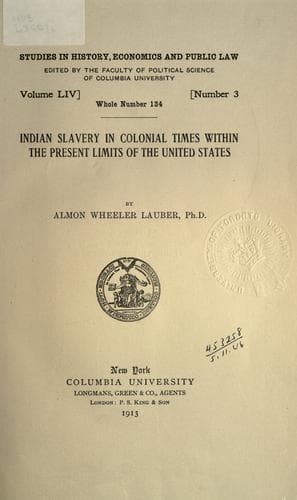
Indian slavery in colonial times within the present limits of the United StatesLauber, Almon Wheeler
History
Indian slavery in colonial times within the present limits of the United States
Lauber, Almon Wheeler
Indians of North America; Indians, Treatment of -- United States; Slavery -- United States; Thesis (Ph. D.)
[1226] It is doubtful whether any definite knowledge of the enslavement
of Indians existed in England. The public criticism of the play and
opera “Incle and Yarico,” which dealt with the capture of two Indian
girls in America and their subsequent sale in Barbadoes, because the
first scene was laid in America, tends to show a general ignorance
on the subject. This play written by Coleman and told in story by
Steele in “The Spectator,” No. 11, March 13, 1710, is supposed to have
been founded on fact. The event is described in Ligon, _History of
Barbadoes_, p. 55. The play is given in Inchbald, _British Theatre_.
[1227] _Massachusetts Historical Society Collections_, series 4, vi, p.
214.
[1228] _Massachusetts Manuscript Records_, xxx, No. 173; _Plymouth
Colony Records_, x, pp. 451–453; _New England Historical and
Genealogical Register_, vi, p. 297 and xxxii, p. 299; Winsor, _The
Memorial History of Boston_, i, p. 322.
[1229] Moore, _Notes on the History of Slavery in Massachusetts_, p.
90. In 1700, Sewall had published a protest against slavery in general
in the form of a tract: _The Selling of Joseph, a Memorial_. The
tract did not mention Indian slavery. Moore, _op. cit._, pp. 83–87;
_Massachusetts Historical Society Proceedings_, 1863–1864, pp. 161–165.
[1230] Sandiford, _The Mystery of Iniquity_, etc., p. 19.
[1231] _Ibid._, p. 96.
[1232] Sharp, _Extract from a Representation of the Injustice_, etc.,
p. 15.
[1233] _Ibid._, p. 13.
[1234] Benezet, _Some Observations on the Situation, Disposition_,
etc., p. 9. In a footnote he refers to Hunt’s kidnapping act.
[1235] _Records of the Friends’ Yearly Meeting of Pennsylvania and the
Jersies_, p. 211; Michener, _A Retrospect of Early Quakerism_, etc.,
pp. 260, 341. According to custom the action of the Yearly Meeting
was at once made known to the various Quarterly Meetings within its
jurisdiction by extracts from its minutes. Such extracts recorded
in the minutes of the various Quarterly Meetings for the year 1719
contain exactly the same expression: “And to avoid giving them occasion
of discontent, it is desired that Friends do not buy or sell Indian
slaves.”
[1236] After 1719 the records show the opposition of the Yearly Meeting
to have been expressed against slavery in general, and no mention is
made of Indian slaves, though the records sometimes read: “negroes and
other slaves.” For the action of the Yearly Meeting at various times
up to the time of the abolition of slavery in Pennsylvania in 1780,
see _Pennsylvania Historical Society Memoirs_, i, p. 392 _et seq._;
Sharpless, _A History of Quaker Government in Pennsylvania_, ii, p. 224
_et seq._; _American Society of Church Publications_, v. ii, (article
by Allen C. Thomas); Michener, _A Retrospect of Early Quakerism_, etc.;
_Pennsylvania Magazine of History_, xiii, pp. 265 _et seq._
[1237] Williamson, _The History of the State of Maine_, etc., i, p. 539.
[1238] _Cf._ above, pp. 173–174.
Public-domain text, read in full here on John Shaqi.
Reviews
Reviews
No reviews yet
Be the first to share your thoughts on this work.
Elsewhere in the archive
Join the Discussion
Join the discussion
Sign in to leave a comment or review.
Sign InorCreate an account