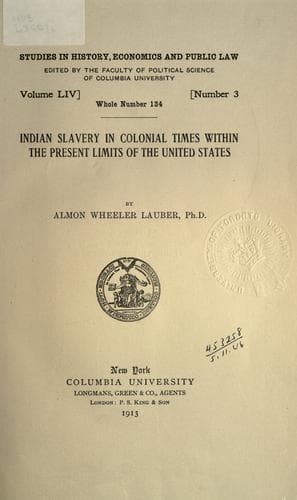
Indian slavery in colonial times within the present limits of the United StatesLauber, Almon Wheeler
History
Indian slavery in colonial times within the present limits of the United States
Lauber, Almon Wheeler
Indians of North America; Indians, Treatment of -- United States; Slavery -- United States; Thesis (Ph. D.)
[1239] Cotton Mather, _Magnalia_, edition of 1820, ii, p. 507; _Diary_,
in _Massachusetts Historical Society Collections_, series 7, vii, pp.
22, 203; Increase Mather, _Ibid._, series 7, viii, p. 232; The Reverend
Mr. Brown of Haverhill (1723), Chase, _History of Haverhill_, pp. 239,
248; The Reverend Mr. Thacher of Milton (1674), Earle, _Customs and
Fashions in Old New England_, p. 84; the Reverend Mr. Callicott of
Dorchester, Tooker, _Cockenoe-de-Long Island_, p. 12; John Winthrop,
_Records of the Court of Assistants, Colony of Massachusetts Bay_,
1630–1692, ii, p. 91; Daniel Gookin, _New England Historical and_
_Genealogical Register_, viii, p. 272; Governor Berkeley of Virginia,
_William and Mary College Quarterly_, vi, p. 214; Colonel Pollock,
acting governor of North Carolina, _North Carolina Colonial Records_,
ii, p. 52; Governor West of South Carolina, Hewat, _op cit._, i, p. 74;
and Governor Moore of South Carolina, Hewat, _op. cit._, i, p. 140, are
important cases in point.
[1240] Sylvester, _op. cit._, i, p. 293; Drake, _Book of the Indians_,
ninth edition, bk. ii, p. 107.
[1241] _Massachusetts Historical Society Collections_, series 4, vi, p.
95.
[1242] _Massachusetts Historical Society Collections_, series 4, vi,
pp. 195–196.
[1243] _Ibid._, series 4, vi, p. 65.
[1244] Hening, _op. cit._, ii, p. 267.
[1245] Ballagh, _A History of Slavery in Virginia_, p. 50.
[1246] Hening, _op. cit._, iii, p. 468.
[1247] Tucker, _A Dissertation on Slavery_, p. 35; Wheeler, _A
Practical Treatise of the Law of Slavery_, p. 19.
[1248] See Ballagh, _op. cit._, p. 50, for a discussion of the
disappearance of this act. Not until 1806 was it discovered that the
act of 1705 was a repetition of that of 1691.
[1249] Ballagh, _op. cit._, p. 51; 1 _Washington_, pp. 123 (Jenkins
_v._ Tom), 233 (Coleman _v._ Dick.)
[1250] Wheeler, _op. cit._, p. 19, (Hudgins _v._ Wright).
[1251] 2 Hening and Munford, p. 149 (Pallas _v._ Hill); James, _English
Institutions and the American Indians_, p. 47, in _Johns Hopkins
University Studies_, xii.
[1252] Wheeler, _op. cit._, p. 18.
[1253] If this interpretation of the acts of 1691 and 1705 be the true
one, then they belong in the same class with the acts of the northern
colonies which were passed at the time of the Tuscarora War for the
purpose of putting an end to the importation of Indians, but which did
not aim to put an end to the status of slavery as applied to Indians.
[1254] _The Statutes at Large of South Carolina_, vii, p. 397. By
previous acts of 1712, 1722 and 1735; South Carolina had specified who
were to be slaves. _Ibid._, vii, p. 352; vii, p. 371; vii, p. 385.
[1255] 3 _Spears_, p. 128 (The State _v._ Harden, 1832): 1
_Richardson_, p. 324 (Nelson _v._ Whetmore, 1844).
[1256] O’Neall, _The Negro Law of South Carolina_, p. 5.
[1257] _Records of the Colony of Rhode Island and Providence
Plantations_, i, p. 243.
Public-domain text, read in full here on John Shaqi.
Reviews
Reviews
No reviews yet
Be the first to share your thoughts on this work.
Elsewhere in the archive
Join the Discussion
Join the discussion
Sign in to leave a comment or review.
Sign InorCreate an account