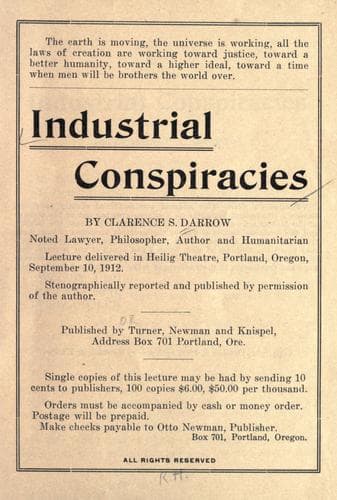
Justice, Administration of -- United States; Working class -- United States
The subject for tonight's talk was not chosen by me but was chosen for
me. I don't know who chose it, nor just what they expected me to say,
but there is not much in a name, and I suppose what I say tonight
would be just about the same under any title that anybody saw fit to
give.
I am told that I am going to talk about "Industrial Conspiracies." I
ought to know something about them. And I won't tell you all I know
tonight, but I will tell you some things that I know tonight.
The conspiracy laws, you know, are very old. As one prominent laboring
man said on the witness stand down in Los Angeles a few weeks ago when
they asked him if he was not under indictment and what for, he said he
was under indictment for the charge they always made against working
men when they hadn't done anything--conspiracy. And that is the charge
they always make. It is the one they have always made against
everybody when they wanted them, and particularly against working men,
because they want them oftener than they do anybody else. (Applause).
When they want a working man for anything excepting work they want him
for conspiracy. (Laughter). And the greatest conspiracy that is
possible for a working man to be guilty of is not to work--a
conspiracy the other fellows are always guilty of. (Applause). The
conspiracy laws are very old. They were very much in favor in the Star
Chamber days in England. If any king or ruler wanted to get rid of
someone, and that someone had not done anything, they indicted him for
what he was thinking about; that is, for conspiracy; and under it they
could prove anything that he ever said or did, and anything that
anybody else ever said or did to prove what he was thinking about; and
therefore that he was guilty. And, of course, if anybody was thinking,
it was a conspiracy against the king; for you can't think without
thinking against a king. (Applause). The trouble is most people don't
think. (Laughter and applause). And therefore they are not guilty of
conspiracy. (Laughter and applause).
The conspiracy laws in England were especially used against working
men, and in the early days, not much more than a hundred years ago,
for one working man to go to another and suggest that he ask for
higher wages was a conspiracy, punishable by imprisonment. For a few
men to come together and form a labor organization in England was a
conspiracy. It is not here. Even the employer is willing to let you
form labor organizations, if you don't do anything but pass
resolutions. (Laughter and applause).
Public-domain text, read in full here on John Shaqi.
Reviews
Reviews
No reviews yet
Be the first to share your thoughts on this work.
Join the Discussion
Join the discussion
Sign in to leave a comment or review.
Sign InorCreate an account