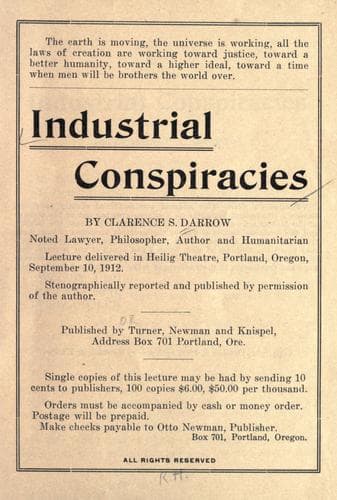
Justice, Administration of -- United States; Working class -- United States
We find the American workingman bound by the law, as I have
said,--everything taken from him. He can't do anything by voting. The
courts are almost always against him, for the simple reason that
courts are made from lawyers, generally prominent lawyers and well
known lawyers. In almost every instance these lawyers have been
corporation lawyers. Their instincts are that way. Their beliefs are
that way, and their training and heredity are that way; and they are
not with the poor.
In order to be a lawyer you must spend considerable time, if not
studying, at least you must spend it not working. You can't work while
you are becoming a lawyer, and you won't work afterwards. (Laughter).
It takes eight or ten years' schooling at least. That is one reason
why a lawyer says he should have big fees, it takes him so long to
learn the trade. That is, the poor people support a lawyer so long
while he is preparing that they ought to support him better while he
is practicing (laughter); because a fellow studying to be a lawyer, or
a doctor, or a minister--I don't know what they study to be a
minister, but I suppose they do (laughter)--has got to be living while
he is studying and somebody must take care of him; to take care of him
while he is learning--after he gets it learned he takes care of
himself.
So the judges are not on your side. They don't look at things the way
you do. They are trained differently. If they were picked out of your
trade councils they would look at them differently and they could
decide cases differently. Everything is in habit, and the environment
and the training, and they are all the time fashioning the law against
you.
Then what? Workingmen find themselves hedged about wherever they turn.
They can't employ themselves. Somebody has got the earth. They can't
mine ore; somebody owns it. They can't get the steel to do the work
with themselves; they have got to buy it off somebody. They can't do
the work except for wages; the employer does it and the employer
insists upon open competition in labor and workingmen are constantly
fighting each other.
Everybody admits that the systems must change, that the laws must
change. They can't change them by political action, and the injustice
goes on, and on, and on.
They find children taken from school and put in factories and mills;
their children, not the children of the rich but the children of the
poor. The rich love their children so much that they don't put them in
factories and mills. Only the children of the poor are put in
factories and mills, which shows that mother love is not the same with
poor people as it is with rich people. Still the poor people have all
the children anyway, so there are enough. (Laughter). They are good to
the rich and they have the children for them.
Public-domain text, read in full here on John Shaqi.
Reviews
Reviews
No reviews yet
Be the first to share your thoughts on this work.
Join the Discussion
Join the discussion
Sign in to leave a comment or review.
Sign InorCreate an account