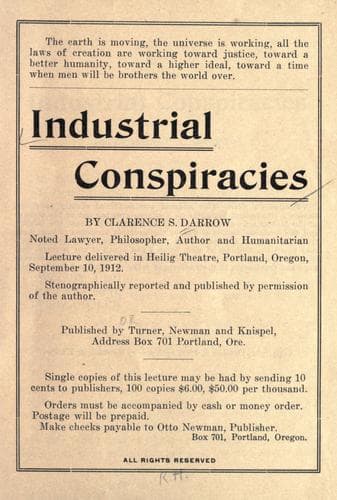
Justice, Administration of -- United States; Working class -- United States
Everybody supposed this law was plain and simple and easily
understood, but when they indicted a combination of capital for a
conspiracy in restraint of trade, the Supreme Court said this law did
not apply to them at all; that it was never meant to fit that
particular case. So they tried another one, and they indicted another
combination engaged in the business of cornering markets, engaged in
the business of trade, rich people, good people. It means the same
thing. (Laughter). And the Supreme Court decided that this law did not
fit their case, and every one began to wonder what the law did mean
anyhow. And after awhile there came along the strike of a body of
laboring men, the American Railway Union. They didn't have a dollar in
the world altogether, because they were laboring men and they were not
engaged in trade; they were working; but they hadn't found anything
else that the Sherman anti-trust act applied to, so they indicted Debs
and his followers for a conspiracy in restraint of trade; and they
carried this case to the Supreme Court. I was one of the attorneys who
carried it to the Supreme Court. Most lawyers only tell you about the
cases they win. I can tell you about some I lose. (Applause). A lawyer
who wins all his cases does not have many. (Laughter).
Debs was indicted for a conspiracy in restraint of trade. It is not
quite fair to say that I lost that case, because he was indicted and
fearing he might get out on the indictment the judge issued an
injunction against him. (Laughter). The facts were the same as if a
man were suspected of killing somebody and a judge would issue an
injunction against him for shooting his neighbor and he would kill his
neighbor with a pistol shot and then they would send him to jail for
injuring his clothes for violating an injunction. (Laughter). Well,
they indicted him and they issued an injunction against him for the
same thing. Of course, we tried the indictment before a jury, and that
we won. You can generally trust a part of a jury anyhow, and very
often all of them. But the court passed on the injunction case, and
while the facts were just the same and the law was just the same, the
jury found him innocent, but the court found him guilty. (Laughter).
And Judge Wood said that he had violated the injunction. Then we
carried it to the Supreme Court on the ground that the Sherman
anti-trust law, which was a law to punish conspiracies in restraint of
trade, was not meant for labor unions but it was meant for people who
are trading, just as an ordinary common man would understand the
meaning of language, but the Supreme Court said we didn't know
anything about the meaning of language and that they had at last found
what the Sherman anti-trust law meant and that it was to break up
labor unions; and they sent Mr. Debs to jail under that law (laughter
and applause), and nobody, excepting someone connected with the union
had ever been sent to jail under that law, and probably never will be.
Public-domain text, read in full here on John Shaqi.
Reviews
Reviews
No reviews yet
Be the first to share your thoughts on this work.
Join the Discussion
Join the discussion
Sign in to leave a comment or review.
Sign InorCreate an account