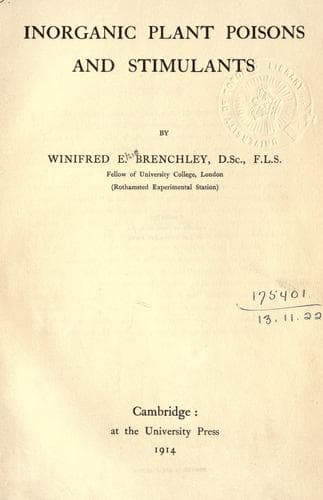
Inorganic Plant Poisons and StimulantsBrenchley, Winifred Elsie
Science
Inorganic Plant Poisons and Stimulants
Brenchley, Winifred Elsie
Growth (Plants); Plants -- Effect of poisons on
Some years before True and Gies published their results, Coupin (1898)
had grown wheat seedlings in culture solutions with the addition of
copper salts for several days in order to find the fatal concentrations
of the different compounds. Taking toxic equivalent as meaning “the
minimum weight of salt, which, dissolved in 100 parts of water, kills the
seedling,” the results were as follows:
Toxic Containing
equivalent copper
Copper bromide (CuBr₂) ·004875 ·001387
Copper chloride (CuCl₂.2aq.) ·005000 ·001865
Copper sulphate (CuSO₄.5aq.) ·005555 ·001415
Copper acetate (Cu{C₂H₃O₂}₂.aq.) ·005714 ·001820
Copper nitrate (Cu{NO₃}₂.6aq.) ·006102 ·001312
These numbers appear to be very close, so Coupin considered that it
might be permissible to regard the differences as due to the impurities
in the salts, and to the water of crystallisation which may falsify the
weights, so that under these conditions one may believe that all these
salts have the same toxicity. This is considerable, and is evidently due
to the copper ion, the electro-negative ion not intervening with such a
feeble dose. A recalculation of these toxic equivalents to determine the
actual amount of copper present in each, gives results that are fairly
approximate, but it is difficult to accept this hypothesis in view of
other work in which different salts of the same poison are proved to
differ greatly in their action on plant growth.
Kahlenberg and True (1896), working with _Lupinus albus_, found that the
various copper salts, as sulphate, chloride and acetate, were similar in
their action upon the roots. Plants placed in solutions of these salts of
varying strengths for 15–24 hours showed that in each case 1/25,600 gram
molecule killed the root, while with 1/51,200 gram molecule the root was
just alive. These workers discuss their results from the standpoint of
electrolytic dissociation, and concur in the opinion that the positive
ions of the toxic salt are exceedingly poisonous.
The toxicity of the positive ion was again set forth by Copeland and
Kahlenberg (1900). Their water culture experiments were carried on in
glass vessels coated internally with paraffin to avoid solution of glass,
and in tests with seedlings of maize, lupins, oats and soy beans it was
found that such metals as copper, iron, zinc and arsenic were almost
always fatal to the growth of plants. As a general rule those metals whose
salts are toxic, themselves poison plants when they are present in water.
The assumption made was that the injury to plants when cultivated in the
presence of pure metals depends on the tendency of the metal to go into
solution as a component of chemical compounds and on the specific toxicity
of the metallic ion when in solution.
(_b_) _Masking effect caused by addition of soluble substances to
solutions of copper salts._
Public-domain text, read in full here on John Shaqi.
Reviews
Reviews
No reviews yet
Be the first to share your thoughts on this work.
Join the Discussion
Join the discussion
Sign in to leave a comment or review.
Sign InorCreate an account