Inorganic Plant Poisons and Stimulants — John Shaqi
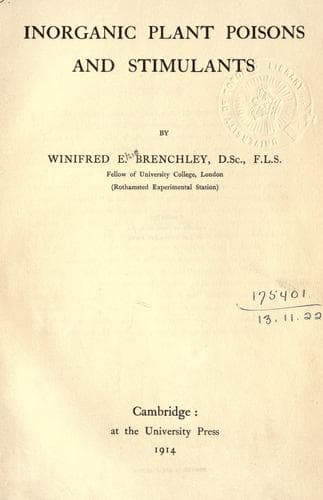
Inorganic Plant Poisons and StimulantsBrenchley, Winifred Elsie
Science
Inorganic Plant Poisons and Stimulants
Brenchley, Winifred Elsie
Growth (Plants); Plants -- Effect of poisons on
mere matter of adaptation and adjustment, since toxic substances are not
usually present in soil, but this assertion is too sweeping to be accepted
in its entirety, although it probably holds good to a certain extent with
some species of plants.
Kahlenberg and True (1896) found that the addition of an organic substance
produced the same effect as the addition of some nutrient salt, in that
it reduced the toxicity of the copper salt, e.g. in the presence of sugar
and potassium hydrate the lupins were able to withstand a concentration of
1/400 copper sulphate, part of which reduction of toxicity is attributed
to the sugar.
(_c_) _Effect of adding insoluble substances to solutions of copper salts._
Other investigators have shown that the presence of insoluble substances
has a similar effect in reducing toxicity to an even greater degree. True
and Oglevee (1904, 1905) again used _Lupinus albus_ as a test plant in
the presence of solutions of various poisons in pure distilled water,
copper sulphate, silver nitrate, mercuric chloride, hydrochloric acid,
sodium hydroxide, thymol and resorcinol all coming under consideration.
Clean sea sand, powdered Bohemian glass, shredded filter paper, finely
divided paraffin wax and pure unruptured starch grains were respectively
added to the solutions, and seedlings were suspended over glass rods so
that their roots were in the solutions for 24–48 hours. The solids varied
in their action on the different poisons; while the toxic influence of
mercuric chloride was reduced by sand and crushed glass, the action of
silver nitrate was modified by nearly all the solids. Lupin roots proved
unable to withstand an exposure of 24 hours to a concentration of copper
sulphate of 1 molecular weight in 60,000 litres of water (i.e. about
1 part by weight CuSO₄.5H₂O in 240·4 parts water), but the addition of
solids caused a great decrease in toxicity. When the amount of copper was
diminished an advantage was regularly obtained in favour of the cultures
containing the solid bodies. On the whole the ameliorating action of
solids is more clearly marked with dilute solutions of strong poisons than
with relatively concentrated solutions of weaker poisons. As a general
rule, filter paper and potato starch grains exert a more marked modifying
action than the denser bodies, such as sand, glass or paraffin.
Breazeale (1906) tested the same point with extracts of certain soils
which proved toxic to wheat seedlings grown in them as water cultures. The
toxicity was wholly or partly removed by the addition of such substances
as carbon black, calcium carbonate or ferric hydrate. Other experiments
showed that the toxic substances of ordinary distilled water are removed
by ferric hydrate and carbon black, and further that the latter substance
will take out copper from copper solutions, rendering them far less
poisonous.
Public-domain text, read in full here on John Shaqi.
Reviews
Reviews
No reviews yet
Be the first to share your thoughts on this work.
Join the Discussion
Join the discussion
Sign in to leave a comment or review.
Sign InorCreate an account