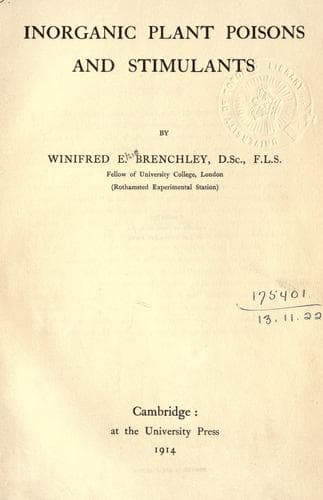
Inorganic Plant Poisons and StimulantsBrenchley, Winifred Elsie
Science
Inorganic Plant Poisons and Stimulants
Brenchley, Winifred Elsie
Growth (Plants); Plants -- Effect of poisons on
The toxic effect of arsenic upon higher plants is much more marked
with arsenious acid and its compounds than with arsenic acid and its
derivatives. No definite evidence of stimulation has yet been obtained
with any arsenic compound, however great the dilution at which it is
applied. With certain algae a stimulus may occur, and it is possible that
arsenic acid is capable of replacing phosphoric acid to some extent under
certain conditions. With fungi the toxic effect of great concentrations
is marked with certain species, but there are others which are capable of
living happily on arsenical compounds and of liberating highly poisonous
arsenic gas.
CHAPTER VI
EFFECT OF BORON COMPOUNDS
I. PRESENCE OF BORON IN PLANTS.
The first claim to the discovery of boron in plants was put forward
in 1857 by Wittstein and Apoiger, who carried out investigations
on the Abyssinian Saoria (seeds of _Maasa_ or _Maessa picta_, N.O.
Primulaceae[12]). In the course of analyses a crystalline mass was
obtained which was found to contain chlorine, phosphoric acid, lime, and
boric acid. The discovery apparently attracted little attention and for
about another thirty years the matter was again allowed to sink into
oblivion. Then it came to the front again, and from 1888 onwards one
investigator after another demonstrated the presence of boron in various
plants.
[12] According to Engler’s classification this plant belongs to N.O.
_Myrsinaceae_.
In 1888 Baumert detected boron in French, German, and Spanish wines
without exception, while E. O. von Lippman (1888) demonstrated it in sugar
must and also in the leaves and root of the sugar beet. In the latter case
the reactions were so definite that the presence of more than a minimal
amount of boric acid was conjectured.
Crampton (1889) tested various fruits, but while he found boron in every
part of the watermelon, he could get no reaction with apples or with
certain samples of sugar cane. He predicted, however, that the occurrence
of boron would prove to be more general in the plant kingdom than had
previously been supposed. The next year (1890) Hotter extended the work
on fruits, testing for boron in the fruits, leaves, and twigs of certain
plants, and finding it in the apple, pear, cherry, raspberry, fig, and
others. His results indicated that fruits are relatively rich in boron.
Later on (1895) Hotter carried his experiments further, and he stated
that stone fruits are richer in boric acid than are berries and pomes.
The accumulation of boron is in the fruit itself, the other parts of the
plant containing little. The quantities of boric acid found in the ash of
the various fruits ranged from ·58% in the “Autumn Reinette” apple to ·06%
in figs. Bechi had previously (1891) detected boron in the ash of figs,
love-apple, and rubus fruits from Pitecio, but he attributed this to the
presence of boric acid or borates in the soil at the place.
Public-domain text, read in full here on John Shaqi.
Reviews
Reviews
No reviews yet
Be the first to share your thoughts on this work.
Elsewhere in the archive
Join the Discussion
Join the discussion
Sign in to leave a comment or review.
Sign InorCreate an account