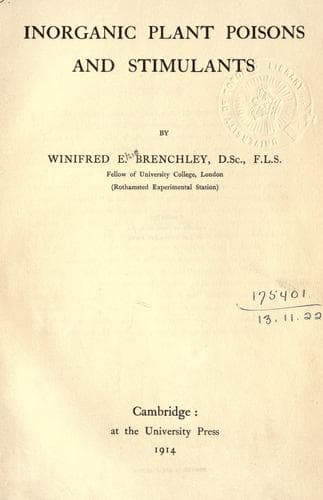
Inorganic Plant Poisons and StimulantsBrenchley, Winifred Elsie
Science
Inorganic Plant Poisons and Stimulants
Brenchley, Winifred Elsie
Growth (Plants); Plants -- Effect of poisons on
Passerini (1891) found traces of boron in the stems of chickpea
plants, while in 1892 Brand determined boric acid in the ash of beer.
In consequence of this various samples of hops were ashed without the
addition of any alkali, and then the ash was distilled with sulphuric
acid and methyl alcohol. When tested all the hops showed relatively large
quantities of boric acid in comparison with beer, hence he argued that
the boric acid in beer is derived from the hops. Boron was discovered in
various parts of the hop plant--in the clusters, leaves, pedicels, and
stems.
Jay (1895) analysed many plants and plant products grown in various soils
and waters, and arrived at the conclusion that boron is of practically
universal occurrence in the plant world. Of all vegetable liquids wines
are the richest in this constituent, the amount varying from ·009 gram to
·33 gram per litre. He confirmed Hotter’s statement as to the richness of
fruits in this substance, finding from 1·50–6·40 grams in 1 kgm. of ash.
Chrysanthemums and onions, amongst other plants, are well off in this
respect, containing 2·10–4·60 grams per kgm. of ash. Jay also found that
the plants vary in their capacity for absorbing boric acid, those which do
so the least easily being Gramineae (as wheat, barley, rice), mushrooms
and watercress, the quantity in these plants never exceeding ·500 grams
per kgm. of ash.
Of all the workers upon boron, Agulhon has done the most to extend and
concentrate our knowledge of the subject. He used the most refined,
up-to-date methods for the detection and estimation of boric acid,
and so determined its presence in many plants, including angiosperms,
gymnosperms, ferns, algae, and fungi. Tobacco is so rich in boron that it
can be detected in the ash of one cigarette. Among the plants tested, the
highest percentages of boric acid were found in _Betula alba_ (1·175% of
ash) and _Laminaria saccharina_ (·682% of ash), the lowest in _Cannabis
sativa_ (·123% of ash). Generally speaking annual plants and parts of
plants seem to have the least boron in the composition of their ashes. In
one and the same plant the durable parts like bark and wood are richer
than the leaves, even in evergreen trees. He indicated that plants seem
to have a great affinity for boron, as even when plants are grown on soils
in which the boron is practically indetectable they always seem to extract
an appreciable quantity of the element.
Public-domain text, read in full here on John Shaqi.
Reviews
Reviews
No reviews yet
Be the first to share your thoughts on this work.
Elsewhere in the archive
Join the Discussion
Join the discussion
Sign in to leave a comment or review.
Sign InorCreate an account