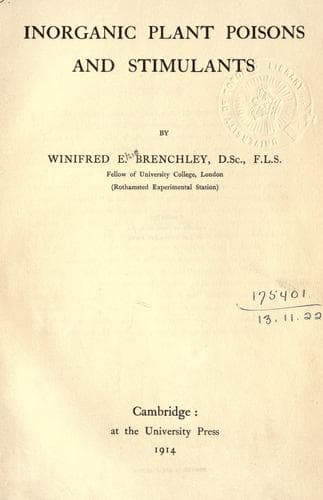
Inorganic Plant Poisons and StimulantsBrenchley, Winifred Elsie
Science
Inorganic Plant Poisons and Stimulants
Brenchley, Winifred Elsie
Growth (Plants); Plants -- Effect of poisons on
From the foregoing results it is evident that boron is very widespread in
the vegetable kingdom, entering into the composition of many plants in all
the great classes. A general impression obtains that its distribution is
universal, and that it will ultimately prove to enter into the composition
of practically every plant, as the scope of the analyses is widened
and as methods of detection are improved. On the other hand, Agulhon is
inclined to think that boron may be a “particular element,” characteristic
of certain groups of individuals or of life under certain conditions.
The series of individuals differ among themselves as to their particular
needs of nutriment (in the widest sense) and doubtless each group has
special need of particular elements, a need that is possibly correlated
with morphological and chemical differences. It may well be that boron is
one of these elements, associated with certain vital functions in a way
as yet unexplained, though it may possibly be found to play some part in
the formation of vascular tissues, since it is most abundant in bark and
lignified parts.
II. EFFECT OF BORON ON THE GROWTH OF HIGHER PLANTS.
1. _Toxic effect._
(_a_) _Toxic action of boron compounds in water cultures._
Excessive quantities of boric acid are decidedly poisonous to plants, the
action being well marked in water cultures. Knop (1884) found that free
boric acid was poisonous in neutral food solutions when present at the
rate of ·5 gram per litre, but he was not able to detect boron in the
ash of the roots of the experimental plants. Archangeli (1885) placed
seedlings of maize, white lupins, _Vicia sativa_ and _Triticum vulgare_
in solutions of boric acid varying in concentration from 1–·05%, with
controls in spring water. In the latter case the development was normal,
with 1% boric acid the plants were killed, while it was found that the
weaker the solution (within the indicated limits) the stronger the root
and shoot growth.
Public-domain text, read in full here on John Shaqi.
Reviews
Reviews
No reviews yet
Be the first to share your thoughts on this work.
Elsewhere in the archive
Join the Discussion
Join the discussion
Sign in to leave a comment or review.
Sign InorCreate an account