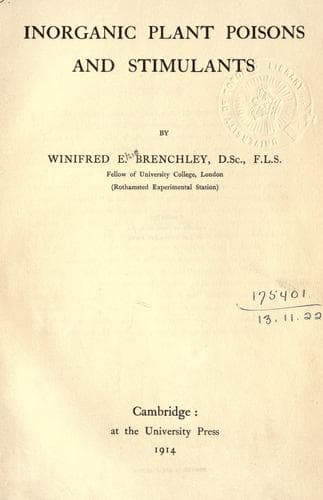
Inorganic Plant Poisons and StimulantsBrenchley, Winifred Elsie
Science
Inorganic Plant Poisons and Stimulants
Brenchley, Winifred Elsie
Growth (Plants); Plants -- Effect of poisons on
Hotter (1890) stated that it was known that 1/20,000 boric acid by weight
was harmful to soy beans in nutritive solutions. He experimented with
peas and maize, placing the seedlings first in distilled water, later
in nutritive solutions. When the peas were nineteen days old they were
transferred to nutritive solutions containing 1/1000–1/100,000 boric acid
by weight per litre, and within three days the plants with 1/1000 showed
signs of injury. Two days later all the plants showed signs of poisoning
in that, even with the weakest strengths, the lower leaves were flecked
with brown, especially at the edges, while with the greater strengths
the lower leaves were dead and the flecking had extended to the upper
leaves. In eleven days from the start the plants with 1/1000 boric acid
were completely dead, while the other plants showed more or less signs of
poisoning. The dry matter and ash decreased steadily with the increase
in the boric acid, while the boric acid per 100,000 parts of dry matter
increased steadily from 8 to 557 parts. Similar experiments were carried
on with potassium borate and with borax; the results showed that, weight
for weight, borax is less toxic than potassium borate, which in turn is
less toxic than boric acid, while at a strength of 1/100,000 there is
little to choose between the three poisons. Similar results were obtained
with maize; plants treated with boric acid or potassium borate yielded
about 2300 parts boric acid in 100,000 parts dry matter. The general
conclusion arrived at by Hotter was that the effect is not so much that
of a general poisoning as of a bleaching of parts of the leaf, mere
traces of boron being harmless. The cause of injury is local inhibition
of assimilation and killing of roots in stronger concentrations. Increase
of the strength of boron raises the toxicity until 1/1000 practically
inhibits increase in dry substance. The boron was found to be fairly
evenly distributed through sound and affected organs.
Kahlenberg and True (1896) worked with seedlings of _Lupinus albus_ L.,
limiting their experiments to those of 15–24 hours in duration. Various
combinations of boron and other substances were tested. With boric acid
alone 2/25 gram molecule per litre killed the plants, with 1/25 they
were apparently just alive, while 1/100 and less had no injurious effect.
Boromannitic acid was possibly more poisonous than the boric acid, while
a combination of boric acid and cane sugar proved slightly less toxic.
The short duration of these experiments limited their scope considerably,
as with certain concentrations the toxic action would not become evident
within the prescribed limits of time.
Public-domain text, read in full here on John Shaqi.
Reviews
Reviews
No reviews yet
Be the first to share your thoughts on this work.
Elsewhere in the archive
Join the Discussion
Join the discussion
Sign in to leave a comment or review.
Sign InorCreate an account