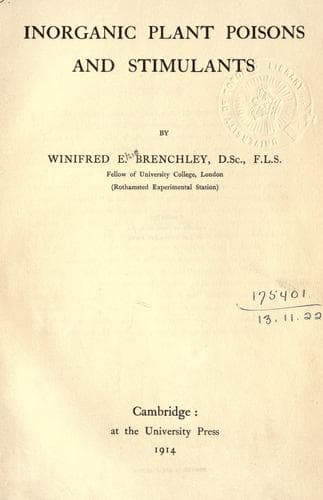
Inorganic Plant Poisons and StimulantsBrenchley, Winifred Elsie
Science
Inorganic Plant Poisons and Stimulants
Brenchley, Winifred Elsie
Growth (Plants); Plants -- Effect of poisons on
Here again the stimulating action was evident with higher concentrations
than in sand cultures, and Agulhon obtained good results with strengths
that are toxic in sand. The evaporation from earth is not so rapid as from
sand, so that the concentration is not increased, and also some of the
boric acid is withdrawn from the solution by interaction with the soil,
so that the stimulating concentration rises in the scale.
In field experiments Agulhon found that peas were more sensitive to the
toxic action of boric acid than is maize. A strength of boric acid (= 1
gm. B per sq. metre) that poisoned peas, gave an increase of 61% fresh
weight and 39% dry weight with maize; half the strength proved to be
indifferent for peas, the improvement with maize equalling 56% increase
fresh and 50% increase dry. Curiously enough, judging by appearances in
the first experiment, an unfavourable influence was at work, though in
reality a great stimulation was being caused. Colza gave a good increase
with similar strengths, but with turnips 1 gm. B per sq. metre only
favoured the aerial parts, while ·5 gm. B per sq. metre only increased
root development. Agulhon concluded that it is as yet impossible to
determine with any precision the exact part that boron plays in the plant
economy. He suggests that boron is a “particulier” element characteristic
of a certain group of individuals or of life under particular conditions.
In his summary he argues that each series of individuals adapted to
different environments has doubtless need of particular elements, and that
perhaps chemical causes and morphological differences are very closely
connected. Boron may be of this “particulier élément” type in the higher
plants of the vegetable kingdom, and it may be useful commercially as a
manurial agent, the “catalytic manure” of Bertrand and Agulhon.
While the higher concentrations of boric acid proved definitely toxic
to both peas and barley in the Rothamsted water cultures, some evidence
of stimulation was obtained with the lower strengths. With barley the
question of stimulation is still an open one, as below the toxic limit
growth seems fairly level in most of the experimental series. The lower
limit of toxicity varies from 40–4 parts boric acid per 10,000,000
according to circumstances. Below this critical concentration the boric
acid has apparently no action, either depressant or stimulant, unless the
stimulation should prove to begin at a dilution of 1/50,000,000, but the
evidence on this point is not sufficiently well marked or consistent to be
conclusive. This failure to detect stimulation was somewhat unexpected, as
when judged by the eye the plants treated with the lower concentrations
of boric acid seemed better than the controls, and also exhibited a
particularly healthy green colouration.
Public-domain text, read in full here on John Shaqi.
Reviews
Reviews
No reviews yet
Be the first to share your thoughts on this work.
Elsewhere in the archive
Join the Discussion
Join the discussion
Sign in to leave a comment or review.
Sign InorCreate an account