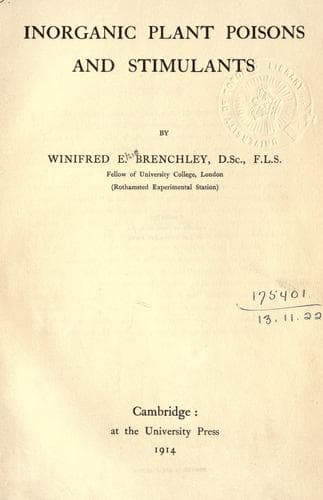
Inorganic Plant Poisons and StimulantsBrenchley, Winifred Elsie
Science
Inorganic Plant Poisons and Stimulants
Brenchley, Winifred Elsie
Growth (Plants); Plants -- Effect of poisons on
Peas on the other hand are definitely stimulated with traces of boric
acid, concentrations of 1/100,000 and less causing an improvement in
growth, while under some experimental conditions even higher amounts
of boric acid were beneficial. All the stimulated plants showed the
characteristic dark green colour which seems to be associated with
the presence of minute traces of boron in the nutritive solution. An
interesting morphological feature was the strong development of small side
shoots from the base of the plants in the presence of medium amounts of
boric acid, from 1 part in 100,000 downwards. This gave rise to a certain
bushiness of growth, which was less evident as the concentration of the
stimulant decreased. The general outcome of the tests seems to be that
boric acid needs to be supplied in relatively great strength to be fatal
to pea plants, and that the toxic action gives place to a stimulative one
high up in the scale of concentration. As far as experiments have already
gone it seems as though the stimulation is not a progressive one, as the
effect of 1/100,000 boric acid is as good as that of 1/20,000,000, a flat
curve connecting the two. This, however, needs confirmation.
Yellow lupins also give some evidence of stimulation with concentrations
of about 1/50,000 boric acid, the improvement being far more strongly
marked in some sets of experiments than in others.
III. EFFECT OF BORON COMPOUNDS ON CERTAIN OF THE LOWER PLANTS.
Our knowledge of the action of boron on the lower plants is less definite
and complete than with regard to the higher plants. Morel (1892) found
that boric acid acts as a strong poison to the lower fungi and similar
organisms, their development being completely arrested by very weak
solutions of the acid. He suggested, on this account, that boric acid
might be used in the same way as copper to attack such diseases as mildew,
anthracnose, &c., which attack useful plants.
On the other hand Loew (1892) stated that such algae as _Spirogyra_
and _Vaucheria_ showed no harmful influence for many weeks when the
culture water contained as much as ·2% (= 1/500) boric acid. This may
be supplemented by a recent observation at Rothamsted, in which certain
unicellular green algae (unidentified), were found growing at the bottom
of a stoppered bottle containing a stock solution of 1/100 boric acid.
Agulhon (1910 a) dealt chiefly with yeasts and certain ferments, and found
that yeasts grown in culture solutions are not influenced favourably or
unfavourably by relatively large quantities of boric acid up to 1 gram
per litre, while all development is checked with 10 grams per litre. The
presence of boron affects the action of yeast on glucose and galactose.
Galactose alone is not attacked even after 40 days in the presence of ·66%
boric acid. When glucose is mixed with the galactose the latter is said
to be at first left untouched, but later it disappears very slowly.
Public-domain text, read in full here on John Shaqi.
Reviews
Reviews
No reviews yet
Be the first to share your thoughts on this work.
Elsewhere in the archive
Join the Discussion
Join the discussion
Sign in to leave a comment or review.
Sign InorCreate an account