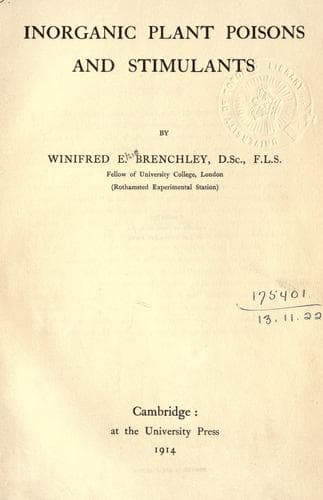
Inorganic Plant Poisons and StimulantsBrenchley, Winifred Elsie
Science
Inorganic Plant Poisons and Stimulants
Brenchley, Winifred Elsie
Growth (Plants); Plants -- Effect of poisons on
The presence of manganese as a constituent of plant tissues has been known
for many years, and in view of the close association between iron and
manganese it was natural that the early investigators should seek for the
latter element. De Saussure (1804) gives one of the earliest references to
manganese in plant ash, stating that it occurs in the seeds in less great
proportion than in the stems, and also that the leaves of trees contain
less in autumn than in spring. At first oxides of iron and manganese
were put together as “metallic oxides” and little or no attempt was made
to separate them so as to get an idea of their relative abundance. John
(1814) gives a number of rough analyses of plants and indicates the
presence of manganese in many plants, including _Solanum tuberosum_,
_Brassica oleracea viridis_ L., _Conium maculatum_, _Aesculus_ (in outer
bark), and _Arundo Sacchar_. No further references presented themselves
until 1847, as probably manganese was overlooked and always classed with
iron in any analyses made during that time. Kane (1847) found traces of
manganese in the ashes of some samples of flax, but none in others, and
examinations of the soils on which the plants were grown gave similar
results. Mayer and Brazier (1849) confirmed this result. Herapath (1849)
analysed the ashes of various culinary vegetables, finding manganese in
cauliflowers, swede turnips, beetroot, and in one variety of potato (Forty
fold).
Malaguti and Durocher (1858) tried to investigate the matter
quantitatively. The oxides of iron, manganese, and aluminium were all
classed together, and the mean percentage of the three varied from
·85%–5·06% according to the varieties of plants concerned, Cruciferae
possessing least and Leguminosae most. Different mean results with the
same plant were obtained from different soils.
Wolff (1871) made other quantitative analyses including _Trapa natans_
(·15% Mn₃O₄), _Acorus Calamus_ (1·52% Mn₃O₄), _Alnus incana_ (trace–·73%
Mn₃O₄), _Pyrus communis_ (2·15% Mn₃O₄). Many other plants were mentioned
by Wolff as containing manganese.
Campani (1876) found manganese in ash by a method in which it was detected
as phosphate of manganese, and he claimed to be the first to discover
manganese in wheat ash. Warden (1878) found traces of Mn₃O₄ in the ash of
opium from Behar.
Dunnington (1878) detected manganese in the ash of wheat, ·00144 gm. (as
Mn₃O₄?) in 300 grams of “Dark Lancaster” variety, equivalent to ·027% of
the pure ash. The ash was exhausted with nitric acid, and after separating
the iron the ammonium sulphide precipitate was found to contain manganese,
and gave by fusion with nitre and sodium phosphate a violet coloured mass.
Andreasch (1878) found slight traces of Mn₃O₄ in the flowers of _Dianthus
caryophyllus_, none occurring elsewhere, while in _Rosa remontana_ it
appeared in both leaves and flowers.
Public-domain text, read in full here on John Shaqi.
Reviews
Reviews
No reviews yet
Be the first to share your thoughts on this work.
Elsewhere in the archive
Join the Discussion
Join the discussion
Sign in to leave a comment or review.
Sign InorCreate an account