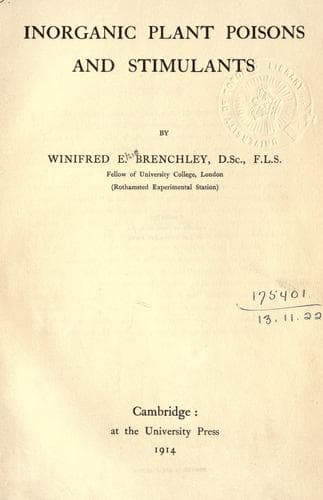
Inorganic Plant Poisons and StimulantsBrenchley, Winifred Elsie
Science
Inorganic Plant Poisons and Stimulants
Brenchley, Winifred Elsie
Growth (Plants); Plants -- Effect of poisons on
Maumené (1884) tested many food plants and concluded that some quantity
of manganese is frequently present in potato, rice, barley, carrot,
lentil, pea, beetroot, asparagus, chicory, most fruits, tea, and also in
some fodder plants, as lucerne, oats, and sainfoin. Ricciardi (1889),
Hattensaur (1891) also added to the list of plants proved to contain
manganese. Guerin (1897) studied the manganese content of woody tissues.
Sawdust was treated with distilled water containing 1% caustic potash,
expressed, and filtered after two or three days. A brown coloured liquid
was obtained, which when treated with a slight excess of hydrochloric acid
gave an abundant flocculent precipitate. This precipitate proved to be
soluble in pure water, so it was washed with slightly acidulated distilled
water, and after further purification was analysed. No trace of iron was
obtained, but about ·402% Mn was found. Guerin regarded the precipitate
as a “nucleinic” combination, which he supposed to occur generally in wood
and to contain the manganese present in the woody tissues of all plants.
Schlagdenhauffen and Reeb (1904) detected manganese in a petrol extract
of such cereals as barley, oats, and maize, and since inorganic salts
of manganese are not soluble in such liquids as ether or petrol they
concluded that the manganese must be present in the plant in organic
combination, thereby upholding Guerin’s view. Loew and Seiroku Honda
(1904) give a table of Mn₃O₄ in the ashes of certain trees. This is very
high in some cases, rising to 11·25% in the ash of beech leaves, 6·73% in
birch leaves, and 5·48% in chestnut fruits.
Gössl (1905) gives lists of the distribution of manganese in plants, both
Thallophytes and Phanerogams, indicating the presence of much or little of
the element. As a rule, he states, marsh and water plants gather up more
manganese than do land plants.
The Gymnosperms seem to be particularly rich in their manganese content.
Schröder (1878) tested for the element in firs and pines and found the
following amounts of Mn₃O₄.
In 100 parts ash. In 1000 parts dry matter.
Fir Pine Fir Pine
33·18 13·46 2·76 ·77
He gave a table of detailed analyses showing the differing proportions of
manganese in the different parts of the fir.
Public-domain text, read in full here on John Shaqi.
Reviews
Reviews
No reviews yet
Be the first to share your thoughts on this work.
Elsewhere in the archive
Join the Discussion
Join the discussion
Sign in to leave a comment or review.
Sign InorCreate an account