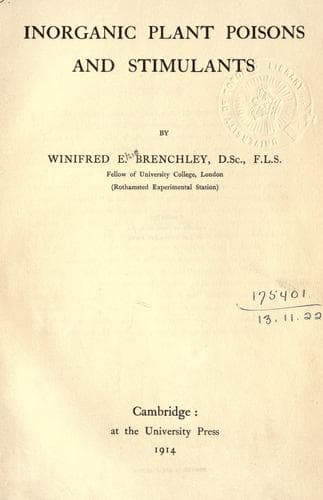
Inorganic Plant Poisons and StimulantsBrenchley, Winifred Elsie
Science
Inorganic Plant Poisons and Stimulants
Brenchley, Winifred Elsie
Growth (Plants); Plants -- Effect of poisons on
Little work seems to have been done on the action of manganese compounds
in water cultures. Knop (1884) just indicated that manganese compounds had
no effect on maize, but gave no details. Japanese investigators touched
on the matter in the course of their extensive experiments with this
element. Asō (1902) found that the greater concentrations of manganese
sulphate exercised an injurious influence on barley. Even in solutions
with as little as ·002% manganese sulphate (= 1/50,000 MnSO₄) the roots
gradually turned brown, the lower leaves following suit. The brown colour
was concentrated at certain points of the leaves, and microscopical
examination showed that the membranes of the epidermal cells, and in some
cases the nuclei, were stained deeply brown. The greatest concentration
endured by barley without injury seemed to be about ·01 per 1000 =
1/100,000. The presence of iron in the food solutions seems to counteract
the effect of the manganese to some extent by delaying the yellowing of
the leaves. Wheat proved very similar to barley in its reactions, though
more iron is necessary to give good healthy growth. Asō states that
wheat is able to overcome the injurious action of manganese much more
readily than is barley. With peas the yellowing of the leaves was delayed,
probably on account of a sufficient supply of iron in the reserve stores
of the seeds.
Loew and Sawa (1902) found that ·25% = 1/400 MnSO₄ (anhydrous) kills pea
plants within five days and that the green colour is gradually affected
with more dilute solutions. Barley and soy beans were grown in nutritive
solutions with either iron sulphate or manganese sulphate or both (·01%
FeSO₄, ·02% MnSO₄, ·01% FeSO₄ + ·02% MnSO₄). At first the growth was
increased by the action of two salts together, but eventually the shoots
turned yellowish, and assimilation was depressed, so that decreased
nutrition led to relaxation in the speed of growth, indicating the toxic
action due to the manganese sulphate.
Public-domain text, read in full here on John Shaqi.
Reviews
Reviews
No reviews yet
Be the first to share your thoughts on this work.
Elsewhere in the archive
Join the Discussion
Join the discussion
Sign in to leave a comment or review.
Sign InorCreate an account