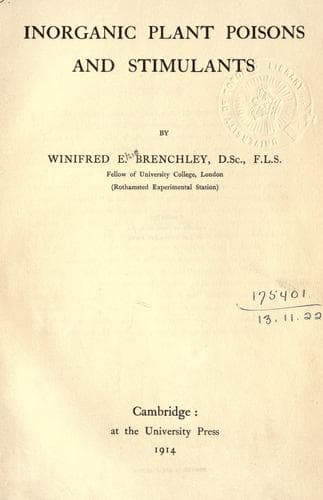
Inorganic Plant Poisons and StimulantsBrenchley, Winifred Elsie
Science
Inorganic Plant Poisons and Stimulants
Brenchley, Winifred Elsie
Growth (Plants); Plants -- Effect of poisons on
The Rothamsted experiments supported Asō’s work on the action of manganese
sulphate on barley, concentrations of the salt above 1/100,000 having a
retarding influence on the growth, the roots being coloured brown and
the leaves also showing discolouration. At an early stage in growth
the lower leaves of the plants receiving the most poison began to be
flecked with brown spots, which were at first attributed to an attack
of rust. Suspicion was soon aroused, however, and a closer microscopic
investigation showed that no disease was present, but that the cells
in the affected spots were dead and brown, though they retained their
shape. The dead cells at first occurred in small patches, which spread
and coalesced until ultimately the whole leaf was involved. Some of the
affected leaves were detached and fused with a mixture of sodium carbonate
and potassium nitrate. On dissolving up the resulting mass with water
a green colouration was obtained, indicating the presence of manganese
in the leaves. This shows that the manganese is taken up by the roots,
transferred to the leaves and then deposited in them, the lower leaves
being the first affected.
The presence of manganese in the nutritive solution retarded the ripening
of the grain to some extent, as when the grains from the control plants
were hard and ripe, those from plants treated with 1/10,000 MnSO₄ were
green, those with 1/100,000 were a mixture of ripe, half-ripe, and green
grains, while plants which had received 1/1,000,000 MnSO₄ possessed ripe
grains.
Peas give similar results to barley so far as the vegetative growth is
concerned, the same retardation with the higher concentrations being
observed, while the brown discoloured patches in the lower leaves are
much in evidence. All traces of manganese in the leaves disappear when the
concentration falls to 1/250,000. On the whole peas are more sensitive to
manganese poisoning than is barley, and the higher strengths of manganese
prove more deleterious to them.
(_b_) _Toxic action of manganese compounds in sand cultures._
Little work has been done on this aspect of the problem. Prince de Salm
Horstmar (1851) grew oats in sand with various combinations of nitrogenous
substances and inorganic mineral salts. He stated that until the time of
fruit formation manganese does not seem to be essential to the oat unless
iron is in excess in the substratum.
(_c_) _Toxic action of manganese compounds in soil cultures._
Public-domain text, read in full here on John Shaqi.
Reviews
Reviews
No reviews yet
Be the first to share your thoughts on this work.
Elsewhere in the archive
Join the Discussion
Join the discussion
Sign in to leave a comment or review.
Sign InorCreate an account