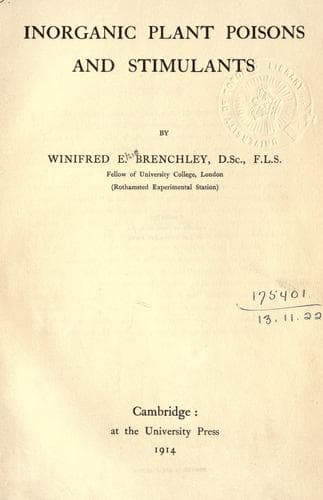
Inorganic Plant Poisons and StimulantsBrenchley, Winifred Elsie
Science
Inorganic Plant Poisons and Stimulants
Brenchley, Winifred Elsie
Growth (Plants); Plants -- Effect of poisons on
Some interesting observations were made by Guthrie and Cohen (1910) on
certain Australian soils. A bowling green that was initially covered with
a healthy mat of couch grass developed a number of small patches after
about three years growth, on which the grass died off. No reason was
apparent for this phenomenon, as the cultural conditions were uniform and
to all appearances the soil over the whole area was similar in character.
Analyses of soil samples from the dead patches and from the neighbouring
healthy parts of the green showed that the chemical composition in both
cases was practically the same, except that while no manganese occurred in
the soil from the unharmed part, as much as ·254% Mn₂O₃ was found in that
from the dead patches. As no other differences were found it was argued
that the manganese, present in such large quantities, acted as a toxic
agent and killed off the grass. Other instances of manganese poisoning
in which wheat and barley were affected are quoted by these authors, the
analytical results indicating that possibly barley is able to withstand
without injury a greater quantity of manganese compounds in the soil than
is wheat.
2. _Effect of manganese compounds on germination._
Nazari (1910) rolled wheat grains in a paste of manganese dioxide,
iron sesquioxide (both with and without organic matter), and in what he
terms “artificial oxydases.” The seeds rolled in the last-named showed
the greatest energy in germination, while those with manganese gave
an appreciable acceleration. The presence of organic matter decreased
the action of manganese. The plants from the manganese seedlings gave
an increased yield in both straw and grain, while those treated with
sesquioxide of iron showed no gain over the check plants.
The Hills Experiments yielded some information as to the differing effects
of various compounds of manganese on germination. With wheat plants in
pot experiments manganese oxide (MnO₂) distinctly retarded germination
when applied at the rate of 2 cwt. per acre. With barley MnO₂, manganese
carbonate and sulphate all retarded germination, while with the iodide
50% of the seeds were entirely prevented from germinating.
3. _Does manganese stimulate higher plants?_
With manganese the evidence in favour of stimulation is more weighty than
with such poisons as copper, zinc and arsenic, and the literature on the
subject is correspondingly plentiful.
(_a_) _Stimulation in water cultures._
Public-domain text, read in full here on John Shaqi.
Reviews
Reviews
No reviews yet
Be the first to share your thoughts on this work.
Elsewhere in the archive
Join the Discussion
Join the discussion
Sign in to leave a comment or review.
Sign InorCreate an account