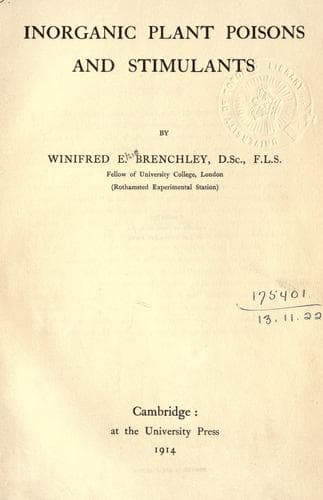
Inorganic Plant Poisons and StimulantsBrenchley, Winifred Elsie
Science
Inorganic Plant Poisons and Stimulants
Brenchley, Winifred Elsie
Growth (Plants); Plants -- Effect of poisons on
A large body of work has been done with manganese in soil cultures, but
the toxic effect is hardly indicated, possibly because it is less manifest
under soil conditions, possibly because the observation of the toxic
action has been almost completely overshadowed by the interest in the
stimulation observed under the same circumstances. Namba stated that ·5
gm. MnSO₄ added to 8 kgm. Japanese soil exerted a depressing influence
on the growth of various plants. The Hills Experiments (1903) indicated
some toxic effect. Various soluble and insoluble salts of manganese were
added to soil in pots at the rate of 2 cwt. per acre, wheat being sown.
On the whole the plants from untreated pots were as good as any with
manganese except those that received manganese nitrate or phosphate.
Manganese iodide distinctly retarded growth. The plants that grew did well
eventually, but development of the ear was greatly or entirely retarded.
If the seeds were soaked in the iodide, a concentration of 10% was found
to be harmful, 5% allowing normal growth. Similar experiments with barley
showed that plants treated with manganese carbonate and sulphate were both
inferior to the untreated plants; with iodide less plants were obtained
and their development was abnormal. Soaking the seeds in the iodide, even
in 10% solution, did not do damage as it did with wheat. The oxides were
apparently innocuous, but gave no increase either in corn or straw.
Kelley (1909) found that on soils in Hawaii in which excessive quantities
of manganese are present (5·61% Mn₃O₄) pineapples do not flourish,
but turn yellow and produce poor fruits, and also that if rather less
manganese is present (1·36% Mn₃O₄) the pineapples show the toxic effect
by yellowing during the winter months, but they recover completely during
the hot summer months. Kelley also observed that the deleterious effect is
hardly noticeable during the first twelve months of growth, and that after
a time a darkening occurs in the colour of the soil, which he attributes
to some change in the constitution of the manganese compounds.
Public-domain text, read in full here on John Shaqi.
Reviews
Reviews
No reviews yet
Be the first to share your thoughts on this work.
Elsewhere in the archive
Join the Discussion
Join the discussion
Sign in to leave a comment or review.
Sign InorCreate an account