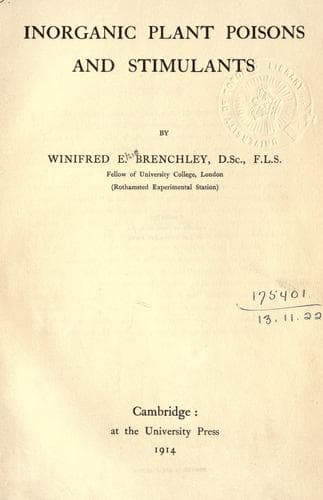
Inorganic Plant Poisons and StimulantsBrenchley, Winifred Elsie
Science
Inorganic Plant Poisons and Stimulants
Brenchley, Winifred Elsie
Growth (Plants); Plants -- Effect of poisons on
Strampelli (1907) tested the effect of manganese dioxide, carbonate,
and sulphate, and of a manganiferous mineral from the Argentine upon
wheat, and found that while all four substances exercised a favourable
influence on the vegetation, the best result was obtained with the
sulphate. When however other manures were used in conjunction with the
manganese compounds the balance of improvement shifted. With nitrogen,
applied as nitrate of soda, manganese dioxide proved the most beneficial,
with farmyard manure the manganiferous mineral[14], and with blood the
carbonate. It was also found that a manganese compost did not increase
production when phosphatic manure was applied as basic slag.
[14] As no analysis of the mineral is given it is obviously
impossible to say to what constituent the increase is due in this
case.
Feilitzen (1907) indicated that the nature of the soil plays its part in
determining whether manganese acts as a stimulant or not. His experiments
were made in the field on poor moor soil, which carried a little Sphagnum
turf and Eriophorum, and which was poor in food salts. The soil was
prepared and manured and then the plots were watered with a solution of ·1
gm. MnSO₄.4H₂O per litre at the rate of 10 kgm. sulphate per hectare, six
control plots being left untreated. Oats were sown and the soil rolled.
During growth no difference was noted between the various plots, and after
harvesting the weights of the different crops showed that the manganese
had not caused increase of crop in either grain or straw on this poor moor
soil.
The great bulk of the work on this problem has been carried out by various
Japanese investigators, whose work extends over several years. Loew and
Sawa (1902) found that small quantities of manganese sulphate in soil
cultures stimulated the growth of rice, pea, and cabbage. They suggested
that soils of great natural fertility contain manganese in an easily
absorbed condition, and that this forms one of the characteristics of such
soils.
Nagaoka (1903) dealt with plots in the rice fields which had not been
manured for the three previous years and which were then treated with
manure at the rate of 100 kgm. ammonium sulphate, 100 kgm. potassium
carbonate and 100 kgm. double superphosphate per hectare. Twelve series
were worked in triplicate and received manganese sulphate in varying
quantities, equivalent to 0–55 kgm. Mn₂O₃ per hectare, one set of three
being left untreated. The cultivation was normal and the application of
manganese was found to influence the yield of rice. 25 kgm. per hectare
gave the best result and increased the harvest of grains by one-third;
higher doses of Mn₂O₃ gave no better crop. The percentage of grain
relative to the straw was also increased. The increase in both respects
was evident all through the series from 10 to 55 kgm. Mn₂O₃ per hectare.
The conclusion was reached that the application of this salt to soils poor
in manganese would be a commercial advantage.
Public-domain text, read in full here on John Shaqi.
Reviews
Reviews
No reviews yet
Be the first to share your thoughts on this work.
Elsewhere in the archive
Join the Discussion
Join the discussion
Sign in to leave a comment or review.
Sign InorCreate an account