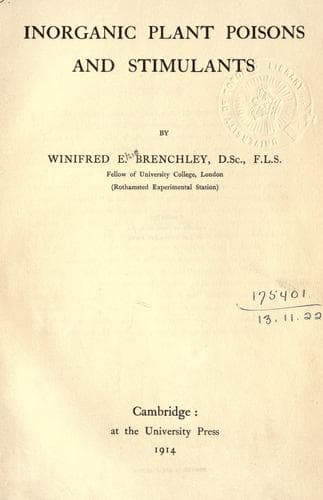
Inorganic Plant Poisons and StimulantsBrenchley, Winifred Elsie
Science
Inorganic Plant Poisons and Stimulants
Brenchley, Winifred Elsie
Growth (Plants); Plants -- Effect of poisons on
It seems probable that all the experimental work that has been
discussed will prove to be simply preliminary to a far greater practical
application of the principle of stimulation or increased growth. While
the physiologists have been feeling their way towards the conclusions
put forth on this subject, the agriculturists have been discovering and
extending the application of artificial manures, until at the present
time such manuring is coming into its own and is receiving more of the
widespread attention that it deserves. The possibility now exists that
in some respects the two lines of work are converging and that the
more purely scientific line will have a big contribution to make to the
strictly practical line. Artificial manuring aims at improvement of the
soil and crop by the addition of food substances that are needed in a
particular soil, a result that used to be obtainable only by the use of
the bulky farmyard manure, seaweed, &c. Apart from any other aspect of
the matter the artificials, when intelligently used, are far more easy
to handle and to regulate in supply, and they yield excellent results,
especially in conjunction with a certain proportion of organic manures.
The further prospect now opened up is the possibility of utilising some
of these stimulating compounds as artificial manures. As only small
traces are beneficial, larger amounts being poisonous, it is obvious
that only small quantities would be needed, and, as the compounds are not
usually very expensive, a considerable increase of crop for a relatively
small outlay might be anticipated if no complicating factors intervened.
Very much work will be required in the field to test the value of these
substances, as their action may be influenced by the nature of the soil,
climatic conditions, general conditions of manuring, and the crops grown.
Some tests have already been made, especially in Japan, with boron and
manganese, and these indicate a promising field for investigation.
Above all, it is most important to realise that one is approaching an
entirely unexplored field, and that it is inevitable that the results of
the initial experiments will be contradictory, at least in appearance,
so that it is necessary to keep an open mind on the subject, being ready
to modify one’s ideas as circumstances require, as improved experimental
methods lead on to more accurate results.
BIBLIOGRAPHY
_The references are to pages on which authors are mentioned. Papers to
which no page-references are appended are not dealt with in the text._
PAGE
ABBA, F. Ueber die Feinheit der biologischen Methode beim
Nachweis des Arseniks. Centr. Bakt. Par. Abt. 2, IV, 806–8.
(1898) 63
ADERHOLD, R. Zur Frage der Wirkung des Kupfers auf die Pflanze.
Ber. Deut. bot. Gesell. XXIV, 112–8. (1906) --
Public-domain text, read in full here on John Shaqi.
Reviews
Reviews
No reviews yet
Be the first to share your thoughts on this work.
Elsewhere in the archive
Join the Discussion
Join the discussion
Sign in to leave a comment or review.
Sign InorCreate an account