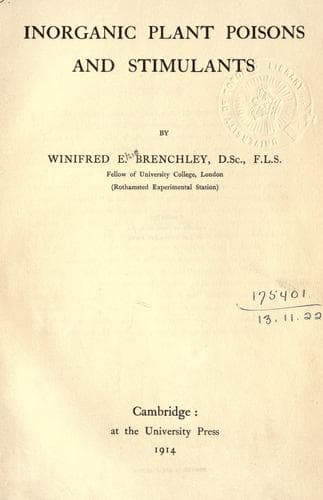
Inorganic Plant Poisons and StimulantsBrenchley, Winifred Elsie
Science
Inorganic Plant Poisons and Stimulants
Brenchley, Winifred Elsie
Growth (Plants); Plants -- Effect of poisons on
The _modus operandi_ of these stimulative agents is not yet fully
understood. Perhaps at the present time two main theories hold the field:
(1) that they act as catalytic agents, being valueless on their own
account, but valuable in that they aid in the procuring of essential food
substances; (2) that the stimulants themselves are of integral value for
nutrition. The French school, with Bertrand at the head, hold strongly
to the catalytic theory, maintaining that manganese and boron compounds
are able to increase growth if they are present in small quantities, as
they act as “carriers” whereby the various functions of the plant are
expedited by the increased facility with which the essential nutritive
elements are supplied. The manganese in laccase, for instance, is held
to be an oxygen carrier, whereby the oxygen is first absorbed and then
released for the benefit of the plant, the manganese being regarded as
essential for the functioning of the enzyme. But, if these elements are
_essential_, this theory seems to stop short of the truth. If certain
functions are dependent for their very occurrence upon the presence
of even minute traces of any element, then surely that element is as
essentially a nutrient element, as vital to the well-being of the plant as
is such an element as carbon or nitrogen or phosphorus, even though the
latter occurs in far greater quantity. It is necessary that one should
free one’s mind from the idea that the quantity of an element present in
a plant is an index of its value to the plant. Naturally enough, in the
early days of plant physiology, the most abundant elements first engaged
the attention of investigators, and they were divided into essential
and non-essential, ten elements being classed in the former category.
More recent work is beginning to show that other elements are constantly
present in plants, but in such small quantities that the older and cruder
methods of analysis failed to reveal them, so that until lately they have
been completely overlooked in work on plant nutrition. Even yet we do
not know which of these other elements are essential and which are merely
accidental. While we do know that the ten essential elements (C, H, O, N,
S, P, K, Mg, Fe, Ca) are necessary for the well-being of all plants, it
is conceivable that these other substances which only occur in very small
quantities may be more individual in their action, and that while a trace
of a certain element may be absolutely essential to one plant, that same
element may be quite indifferent for another species. If one takes a broad
outlook, the two theories seem to be in reality only parts of one, the
“nutrition” theory carrying matters a little farther than the “catalytic”
idea, broadening its scope and extending its application.
Public-domain text, read in full here on John Shaqi.
Reviews
Reviews
No reviews yet
Be the first to share your thoughts on this work.
Elsewhere in the archive
Join the Discussion
Join the discussion
Sign in to leave a comment or review.
Sign InorCreate an account