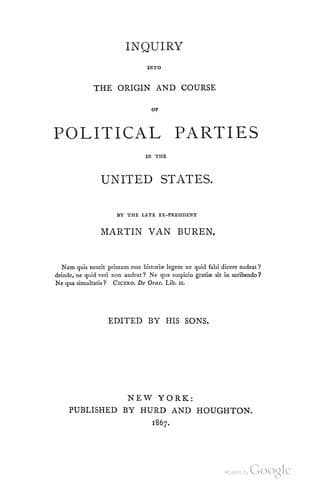
Inquiry Into the Origin and Course of Political Parties in the United StatesVan Buren, Martin
History
Inquiry Into the Origin and Course of Political Parties in the United States
Van Buren, Martin
Political parties -- United States
he should be found mousing over the words of the Constitution for
equivocal expressions, containing a meaning intelligible only to the
initiated, and by such methods preparing to spring a trap upon the
people, was, it appeared to me, utterly foreign to his nature and
habits. Neither was I disposed to believe that he would, at the very
moment of signing, have denounced the Constitution as inadequate to the
purposes of good government if he had then regarded it as possessing the
very extensive powers he afterwards assisted in claiming for it, nor
would he have subsequently declared it to be "a frail and worthless
fabric." His complaint upon the latter occasion would have been against
the construction that had been given to it, and not against the
Constitution itself.
Morris, whose ability no one will question, was a constant attendant
upon the Convention, took an active part in its proceedings throughout,
was on most of its committees and the _working-man_ of the last,--the
duties of which were "to revise the style of, and arrange the articles
which had been agreed to by the House,"--and the second and last draft
of the Constitution was reported by him. But it is now comparatively
unimportant with whom the latitudinarian construction of the
Constitution, which has caused so much strife and contention and so
little advantage to any person, party, or interest, originated.
Hamilton, at least, adopted it as the corner-stone of his constitutional
views, and, by his genius and the weight of his official influence, gave
it a temporary success.
For reasons which will appear in the sequel, I will confine myself to a
simple statement of the questions that were raised in respect to the
construction of the Constitution, and a few illustrations of their
character. That instrument, as has already been stated, contained a
specific enumeration of the powers given to Congress, and the reasons
have been also described for this particularity. The measures to which
they referred were known by appropriate and distinct names, and applied
to definite and well understood objects, and they have been ever since
known and understood as they were then. This enumeration of the powers
of Congress was followed, as we have seen, by a grant of authority to
that body to "make all laws which shall be necessary and proper for
carrying into execution the foregoing powers."
Public-domain text, read in full here on John Shaqi.
Reviews
Reviews
No reviews yet
Be the first to share your thoughts on this work.
Elsewhere in the archive
Join the Discussion
Join the discussion
Sign in to leave a comment or review.
Sign InorCreate an account