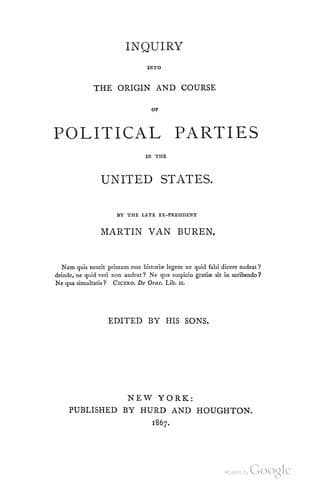
Inquiry Into the Origin and Course of Political Parties in the United StatesVan Buren, Martin
History
Inquiry Into the Origin and Course of Political Parties in the United States
Van Buren, Martin
Political parties -- United States
Under this winding-up clause of the Constitutional enumeration of the
powers of Congress, the true sense and object of which was so easy to be
understood, Hamilton claimed for that body the power of authorizing by
law measures of a substantive character, described by well understood
names, altogether different from those employed in the enumeration, such
as the incorporation of banks, &c., &c., if Congress should declare
itself of the opinion that the execution of the enumerated powers would
be materially aided by any such measures, reserving to Congress the
right of deciding whether the proposed measure would be sufficiently
useful to create the "propriety and necessity" required by the
Constitution, and placing in its breast alone the final decision of
every such question.
The objects of the Constitution, as set forth in its preamble, were "to
form a more perfect union, establish justice, insure domestic
tranquillity, provide for the common defense, promote the general
welfare, and secure the blessings of liberty to ourselves and our
posterity." The first of the powers of Congress, contained in the
enumeration of them in the Constitution, is in the following words:
"The Congress shall have power to lay and collect taxes, duties,
imposts, and excises, to pay the debts and provide for the common
defense and general welfare of the United States; but all duties, and
imposts, and excises shall be uniform throughout the United
States;"--and then follow all the other powers, to borrow money, &c.
Public-domain text, read in full here on John Shaqi.
Reviews
Reviews
No reviews yet
Be the first to share your thoughts on this work.
Elsewhere in the archive
Join the Discussion
Join the discussion
Sign in to leave a comment or review.
Sign InorCreate an account