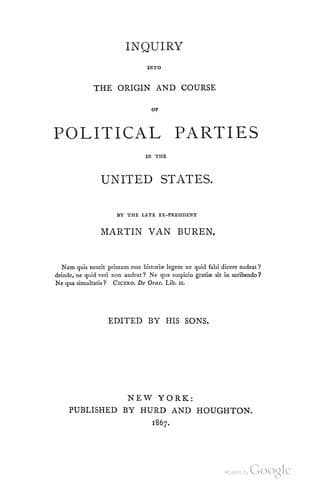
Inquiry Into the Origin and Course of Political Parties in the United StatesVan Buren, Martin
History
Inquiry Into the Origin and Course of Political Parties in the United States
Van Buren, Martin
Political parties -- United States
President Washington gave no reasons for his decision in favor of the
Bank Bill. I will hereafter state the principle upon which I think it
fair to presume that he acted. Hamilton was influenced by views which
governed his conduct in every constitutional question that arose in his
day. He did not, because he could not with any show of propriety, deny
that the Constitution ought in strictness to be construed according to
the intentions of those who made it; but believing, doubtless sincerely,
from the beginning, that, so construed, it was insufficient for the
purposes of good government and must prove a failure, he designedly gave
it construction, in cases where he deemed that course necessary to the
public interest, in opposition to what he knew to have been the
intentions of the Convention. The objection that this was setting at
naught the declared will of the people had but little weight with him.
He believed that a majority of the Convention would have been content to
incorporate the powers he now claimed in the Constitution if they had
not been deterred by the fear that it would not be ratified, and for the
opinion of a majority of the people he made proverbial his want of
respect. He held them incapable of judging in such questions. He was as
anxious as any man to promote their happiness and welfare, but he
thought it a political necessity that this could only be done in despite
of themselves; no man could possibly be less prone than he was to the
employment of sinister means in private life, and yet he held them
excusable in dealing with the people; he thought nothing effectual and
salutary could be done with them without appeals to their special
interests, without exciting their passions and turning them to the side
of the Government. This was the vicious feature of his political creed,
and proofs of its existence could be multiplied almost without end; but,
as the subject will unavoidably and often present itself, I will content
myself here with an extract from a letter written by him to his friend
Morris, after the great public transactions in which he had been engaged
were principally ended. The last letter to Morris, from which I have
quoted, spoke of the past; this looks to the future, and shows the
lengths to which he was yet, as he had always been, willing to go. The
letter is dated April 6, 1802, in which, after complimenting Morris upon
his efforts "in resisting the follies of an infatuated administration,"
he thus points his friend to the work before them:--
Public-domain text, read in full here on John Shaqi.
Reviews
Reviews
No reviews yet
Be the first to share your thoughts on this work.
Elsewhere in the archive
Join the Discussion
Join the discussion
Sign in to leave a comment or review.
Sign InorCreate an account