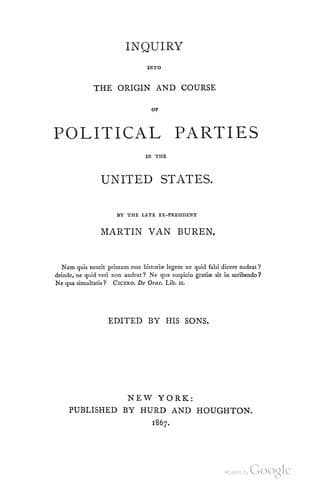
Inquiry Into the Origin and Course of Political Parties in the United StatesVan Buren, Martin
History
Inquiry Into the Origin and Course of Political Parties in the United States
Van Buren, Martin
Political parties -- United States
The nearness of the time when the Constitution was framed to the period
of which we are speaking gave to this construction its most repulsive
aspect. The members of the Federal Convention were yet on the stage of
action, and many of them participators in the measures that were brought
forward on the strength of it. The remonstrances of those who dissented
on the ground of their own knowledge that the Convention did not
contemplate such a construction were disregarded, not because they did
not represent the truth but because the objection was inadmissible upon
principle. This was emphatically the case in respect to the
establishment of a national bank, the pioneer of constitutional
infractions, the "wooden horse" from whose sides the most violent
assaults have been made upon the Constitution. It was a fact well
remembered by the members, and subsequently confirmed by the publication
of the journal of the Convention, that a motion was made to give to
Congress power to grant acts of incorporation, as facilities to public
improvements. This fact was brought to the notice of President
Washington by Mr. Jefferson, in his opinion upon the bank question: "It
is known," said he, "that the very power now proposed as _a means_ was
rejected _as an end_ by the Convention which formed the Constitution; a
proposition was made to them to authorize Congress to open canals, and
an amendatory one to empower them to incorporate, but the whole was
rejected, and one of the reasons of rejection urged in the debate was
that then they would have power to erect a bank, which would render the
great cities, where there were prejudices or jealousies upon this
subject, adverse to the reception of the Constitution."
This communication was made directly to General Washington, who had been
President of the Convention, and made to defeat a measure of Hamilton's,
who never failed to turn every proposition of his opponents against
themselves when it was in his power to do so. It remained unnoticed, and
its truth was therefore virtually admitted. Upon the very first
question, then, which arose under the Constitution upon Hamilton's
construction, and that one first also in importance, the well-known
intentions of the Convention were directly and intentionally overruled.
Public-domain text, read in full here on John Shaqi.
Reviews
Reviews
No reviews yet
Be the first to share your thoughts on this work.
Elsewhere in the archive
Join the Discussion
Join the discussion
Sign in to leave a comment or review.
Sign InorCreate an account