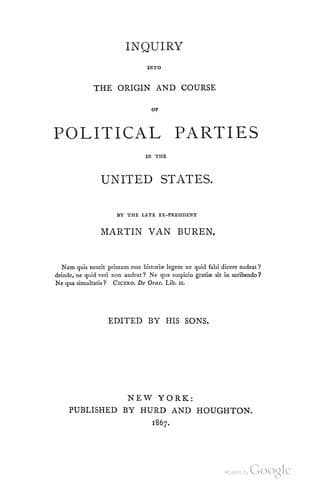
Inquiry Into the Origin and Course of Political Parties in the United StatesVan Buren, Martin
History
Inquiry Into the Origin and Course of Political Parties in the United States
Van Buren, Martin
Political parties -- United States
The names of these parties, like those of their predecessors in older
countries, have from time to time been changed, from suggestions of
policy or from accidental causes. Men of similar and substantially
unchanged views and principles have, at different periods of English
history, been distinguished as Cavaliers or Roundheads, as Jacobites or
Puritans and Presbyterians, as Whigs or Tories. Here, with corresponding
consistency in principle, the same men have at different periods been
known as Federalists, Federal Republicans, and Whigs, or as
Anti-Federalists, Republicans, and Democrats. But no changes of name
have indicated--certainly not until very recently, and the depth and
duration of the exception remain to be seen--a change or material
modification of the true character and principles of the parties
themselves. The difference between the old Republican and the
Anti-Federal parties, arising out of the questions in regard to the new
Constitution, was by far the greatest variation that has occurred.
Several hasty and but slightly considered attempts have been made to
define the origin, and to mark the progress, of our national parties.
But, with a single exception,--namely, that made by ex-President John
Quincy Adams, in his Jubilee Discourse before the New York Historical
Society, on the 30th of April, 1839, being the Fiftieth Anniversary of
the Inauguration of George Washington as President of the United
States,--they have not professed, so far as they have fallen under my
notice, to do more than glance at the subject.
Public-domain text, read in full here on John Shaqi.
Reviews
Reviews
No reviews yet
Be the first to share your thoughts on this work.
Join the Discussion
Join the discussion
Sign in to leave a comment or review.
Sign InorCreate an account