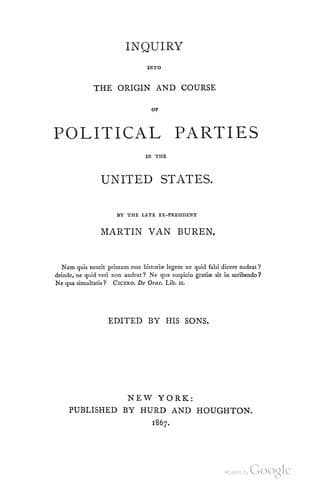
Inquiry Into the Origin and Course of Political Parties in the United StatesVan Buren, Martin
History
Inquiry Into the Origin and Course of Political Parties in the United States
Van Buren, Martin
Political parties -- United States
The rival powers of the state had down to that period consisted of the
crown and the landed aristocracy. The measures out of which the money
power was constructed were designed, as has been stated, to render the
former, restored to greater favor with the nation by the Revolution,
more independent of the latter than it had hitherto been. This new power
had not only performed its duty in that regard, acting in the capacity
of umpire between the crown and the landed aristocracy, (the latter
before so omnipotent,) but had at times found itself able to control the
action of both through the influence of public opinion, to which it had
given a vitality and force it never before possessed.
Mr. Bancroft, in his able history of the United States, has given a
condensed and I have no doubt a very correct account of the rise and of
a part of the progress of the money power in England, as they are
presented by her historians. His entire remarks upon the subject are
full of interest and instruction, and I regret that I am obliged to
restrict myself to the following extract:--"Moreover, as the expenses of
wars soon exceeded the revenue of England, the government prepared to
avail itself of the largest credit which, not the accumulations of
wealth only, but the floating credits of commerce, and the funding
system could supply. The price of such aid was political influence. That
the government should, as its paramount policy, promote commerce,
domestic manufactures, and a favorable balance of trade; that the
classes benefited by this policy should sustain the government with
their credit and their wealth, was the reciprocal relation and
compromise on which rested the fate of parties in England. The floating
credits of commerce, aided by commercial accumulations, soon grew
powerful enough to balance the landed interest; stock aristocracy
competed with feudalism. So imposing was the spectacle of the
introduction of the citizens and of commerce as the arbiter of
alliances, the umpire of factions, the judge of war and peace, that it
roused the attention of speculative men: that at last Bolingbroke,
claiming to speak for the landed aristocracy, described his opponents,
the Whigs, as the party of the banks, the commercial corporations, and
'in general, the moneyed interest;' and the gentle Addison, espousing
the cause of the burghers, declares nothing to be more reasonable than
that 'those who have engrossed the riches of the nation should have the
management of its public treasure, and the direction of its fleets and
armies.' In a word the old English aristocracy was compelled to respect
the innovating element embodied in the moneyed interest."[22]
[22] 3 Bancroft's _History of the United States_, p. 8.
Public-domain text, read in full here on John Shaqi.
Reviews
Reviews
No reviews yet
Be the first to share your thoughts on this work.
Elsewhere in the archive
Join the Discussion
Join the discussion
Sign in to leave a comment or review.
Sign InorCreate an account