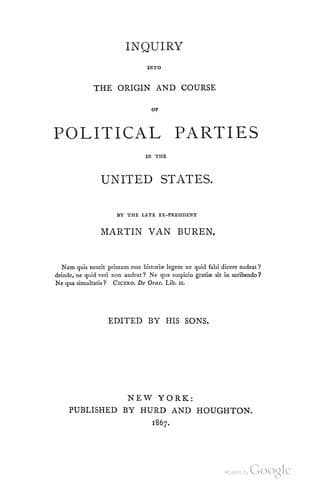
Inquiry Into the Origin and Course of Political Parties in the United StatesVan Buren, Martin
History
Inquiry Into the Origin and Course of Political Parties in the United States
Van Buren, Martin
Political parties -- United States
The full establishment here of a similar power, by attaching to the bank
and funding systems the political influence they had acquired in
England, was, beyond all doubt, the "other and still other stages of
improvement" alluded to by Hamilton in his encouraging conversation with
Jefferson, in which he expressed a hope, for the first time, that the
inadequacy of the Constitution might yet be overcome, and the necessity
of returning to the English _form_ be at least postponed. That the
leading supporters of his policy at least understood and entered into
Hamilton's views will be seen in the following extract from a letter
written to him by Fisher Ames, which will be found in the first volume
of Randall's "Life of Jefferson," at p. 638: "All the influence of the
moneyed men ought to be wrapped up in the Union (Federal Government) and
in one Bank," &c.
Of the three great elements of power under the English system--the
crown, the landed aristocracy, and the moneyed interest--Hamilton
regarded the latter, I have no doubt, as the most salutary even in
England. There was little in the pride, pomp, and circumstance of the
kingly office, and still less in the feudal grandeur of a landed
aristocracy, to captivate a mind like his; he advocated the monarchical
form for special reasons of a very different character, and these he
assigned in the Convention. Indeed, he all but expressed this
preference when he said to John Adams,--"Strike out of the English
system its corruptions and you make the government an impracticable
machine." Corruption in some form being the means by which the money
power ordinarily exerts its influence, Hamilton was not slow in
foreseeing the advantages to be derived from that power in the United
States. It is true that the influence it exerted in England was liberal
in its character, and beneficial, at least in its political bearings, to
the middle classes. We have seen that one object and a principal effect
of its establishment was to reduce the overshadowing influence of the
landed aristocracy which existed so long and exerted a sway so imperious
over the country--an object in the accomplishment of which the members
of the "stock aristocracy" were, in all probability, not a little
stimulated by recollections of their past exclusions not only from all
participation in the management of public affairs, but also from many
social distinctions. The landed aristocracy of England is composed of a
race of men superior in manly virtues and consistency of character to
similar classes in other countries, but notwithstanding these undeniable
and commendable traits they are, by force of their condition and by the
law of their minds, in a great degree the result of that condition,
unwilling to extend to their unprivileged fellow-subjects that equality
in public and private rights to which we republicans consider them
justly entitled. In this respect there is no difference between them, be
Public-domain text, read in full here on John Shaqi.
Reviews
Reviews
No reviews yet
Be the first to share your thoughts on this work.
Elsewhere in the archive
Join the Discussion
Join the discussion
Sign in to leave a comment or review.
Sign InorCreate an account