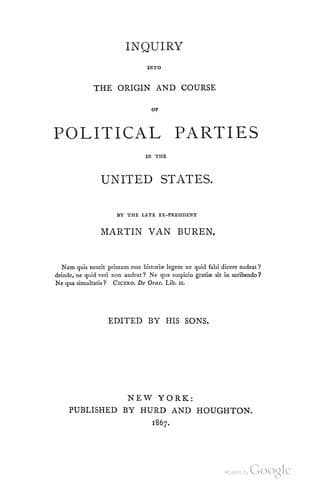
Inquiry Into the Origin and Course of Political Parties in the United StatesVan Buren, Martin
History
Inquiry Into the Origin and Course of Political Parties in the United States
Van Buren, Martin
Political parties -- United States
I have already spoken of the extent to which the public mind was excited
by Hamilton's measures. Large portions of the people regarded the most
prominent among them as violations of the Constitution, and most of them
as servile imitations of the English system, inexpedient in themselves
and contrary to the genius and spirit of our institutions. Their
arraignment and vindication brought into the political field the ablest
men of the country at a period when she abounded in great men. The
American Revolution accomplished here that which the French Revolution,
then at its commencement, and similar crises in all countries and times,
have brought about, namely, the production of great men by great events,
developing and calling into action upon a large scale intellects the
powers of which, but for their application to great transactions, might
have remained unknown alike to their possessors and to the world. Among
the master minds which were thus roused to political activity were
Thomas Jefferson, Alexander Hamilton, James Madison, Patrick Henry, John
and Samuel Adams, John Jay, Chancellor Livingston, Gouverneur Morris,
George Clinton, Robert Yates, Chancellor Lansing, John Langdon, Elbridge
Gerry, Rufus King, Roger Sherman, John Dickinson, Speight and Williamson
and the Rutledges, Pinckneys, and Middletons of North and South
Carolina, Chace and Luther Martin of Maryland, Jackson, Few, and
Baldwin, of Georgia, John Mason, Marshall, Pendleton, and Wythe of
Virginia, and others; men, some of whom have under various circumstances
added celebrity to the best informed communities in the world and at one
of the brightest periods of the human intellect, and who, if they could
now be congregated, would eclipse the great men of any country.
Hamilton's measures, of which the funding system was the pioneer,
presented their first field, after the adoption of the Federal
Constitution, for the display of their opinions and talents. They
supported in those grave discussions, with few exceptions, relatively
the same principles by which they had been influenced in respect to
federal politics during the government of the Confederation, by which
also they and men of their stamp had been governed under the colonial
system, and to which they would have adhered, in all probability,
throughout the intermediate period if they had not been driven into open
rebellion by the indiscriminate and intolerable oppression of a bigoted
tyrant, and by their own innate hatred of wrong and outrage, without
immediate regard to the government that should result from their
revolution.
Public-domain text, read in full here on John Shaqi.
Reviews
Reviews
No reviews yet
Be the first to share your thoughts on this work.
Elsewhere in the archive
Join the Discussion
Join the discussion
Sign in to leave a comment or review.
Sign InorCreate an account