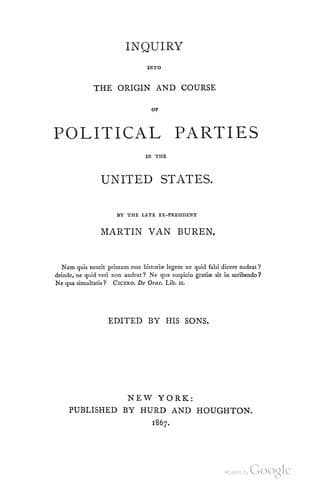
Inquiry Into the Origin and Course of Political Parties in the United StatesVan Buren, Martin
History
Inquiry Into the Origin and Course of Political Parties in the United States
Van Buren, Martin
Political parties -- United States
Jefferson was absent from the country during a large portion of the
government of the Confederation, and through the entire period of the
formation and adoption of the new Constitution. He sympathized
throughout with the feelings and concurred in the opinions of the
Anti-Federal party, with the exceptions that he was not opposed to
conferring on the Federal Government the powers to regulate commerce and
to raise its own revenues; was in favor of a convention for the
construction of a new constitution, and of the formation by that body of
a substantive and effective federal government, composed of legislative,
executive, and judicial departments; approved of the Constitution as
made, with modifications which were principally provided for by
amendments proposed and adopted, and was sincerely anxious for its
ratification. These things have, I know, been controverted and are still
disbelieved by many, but will be found fully established by references
to the following documents, viz.: Jefferson's "Correspondence," Vol. I.
p. 441; Vol. II. pp. 64, 162, 221, 236, 273, 303; Letter to Washington
expressing his anxiety for the adoption of the Constitution; p. 310,
some strong remarks in favor of it; p. 342, to Madison, congratulating
him on its adoption, and p. 348, to John Jay, to the same effect.
Of Madison's character and general course I have already spoken. His
position at the period now under consideration differed from that of all
his contemporaries in the public service. He had supported all the
commercial and financial measures advocated by the Federal party during
the government of the Confederation, and had been as active, and I think
as efficient, as Hamilton in his efforts to promote the call of the
Federal Convention; had opposed, with ability and firmness, the
Anti-Federal plan of a Constitution; had, as far as we have knowledge of
Washington's opinions, acted in concert with him in the Convention, and
was first selected by him at a later period to prepare his Farewell
Address; had combined his labors with those of Hamilton and Jay to
promote the ratification of the Constitution by the well-known papers of
the "Federalist," and, upon the whole, had done more than any other man
to secure that great object. Yet there had been no time, as before
observed, when he could with propriety have been regarded as a member of
the Federal party, in the sense in which Hamilton, Adams, and Jay were
so regarded, or when he did not possess the confidence of the
Anti-Federal party, in respect to all public questions other than those
to which I have referred, and, what is still more remarkable, there was
not, during the whole of this period, a single occasion on which his
perfect probity and disinterestedness were not very generally felt and
acknowledged.
Public-domain text, read in full here on John Shaqi.
Reviews
Reviews
No reviews yet
Be the first to share your thoughts on this work.
Elsewhere in the archive
Join the Discussion
Join the discussion
Sign in to leave a comment or review.
Sign InorCreate an account