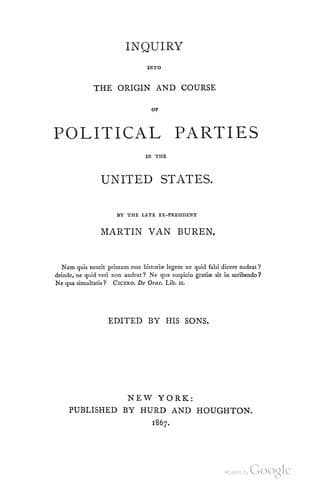
Inquiry Into the Origin and Course of Political Parties in the United StatesVan Buren, Martin
History
Inquiry Into the Origin and Course of Political Parties in the United States
Van Buren, Martin
Political parties -- United States
Among the leading politicians of the epoch of which I speak, the
preponderance in numbers, in wealth, in social position, and possibly in
talent, was on the side of Hamilton; and when to these were added the
commercial and numerous other classes interested in and dependent upon
the money power then just rising into importance, an estimate may be
formed of his ability to give tone and direction to the state and to
society, and to cover with odium those who disapproved of his measures
by charging them with personal hostility to Washington, who so well
deserved the confidence and good will of all, and who enjoyed them to an
extent that led John Adams, at a much later day, to stigmatize the
deference paid to him as "impious homage." Hamilton wielded this great
power with tremendous effect, for, although his judgment in the
management of men was always deemed defective, he exerted, in the
promotion of his particular objects, talents and industry which could
not fail to produce great results. His activity and capacity for labor
were not equaled by any of his contemporaries save Madison; his powers
of persuasion and the effects of his eloquence were strikingly
exemplified by his success in making Mr. Jefferson believe, on his first
arrival at the seat of government from France, that the safety of the
Union depended upon the passage of the bill for the assumption of the
State debts, which had been at the moment rejected in the House of
Representatives by a majority of one or two, and in inducing him to
"hold the candle," as Jefferson afterwards described it, to a bargain by
which Messrs. White and Lee, Southern members, were prevailed upon to
vote for its reconsideration and passage on condition that Hamilton
would get the requisite number of Northern members to vote for the
establishment of the seat of the Federal Government on slave territory.
Jefferson gives an interesting account of the earnestness of Hamilton's
appeal to him on the subject, and of his own mortification and regret at
having been made a party to so exceptionable a transaction in support of
a measure he soon found the strongest reasons to condemn.[23]
[23] Jefferson's _Correspondence_, Vol. 4. p. 449.
Public-domain text, read in full here on John Shaqi.
Reviews
Reviews
No reviews yet
Be the first to share your thoughts on this work.
Elsewhere in the archive
Join the Discussion
Join the discussion
Sign in to leave a comment or review.
Sign InorCreate an account