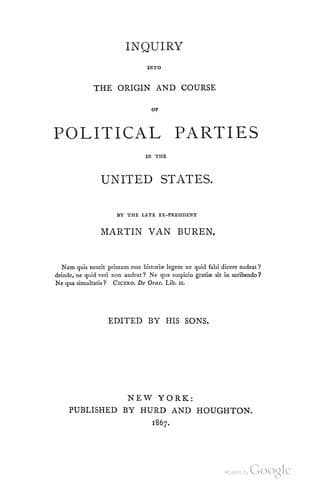
Inquiry Into the Origin and Course of Political Parties in the United StatesVan Buren, Martin
History
Inquiry Into the Origin and Course of Political Parties in the United States
Van Buren, Martin
Political parties -- United States
In this description of the early, which is also measurably and
comparatively true of the present, state of the South, we find a
solution of the circumstance that the failure of Hamilton's policy was
so much more signal there than in other quarters, and that the
principles upon which it was founded have there been since so
perseveringly and unitedly resisted. The political principles of the
landed interest, constituting an immense majority of their people, have
prevailed in the administration of their State governments, save in
regard to the ratification of the Federal Constitution, from the
recognition of our Independence to the present day. There has also been
a remarkable consistency in the political positions of their public men.
In Virginia, which State has done so much to give a tone to national
politics, Patrick Henry has been almost, if not quite, the only
prominent man who abandoned the principles by which he had been governed
during the Confederation, and embraced those of Hamilton at the coming
in of the new government. Always admiring his character and conduct
during the Revolutionary era, and strongly impressed by the vehemence
and consistency with which he had, during the government of the
Confederation, opposed every measure that savored of English origin, I
pressed Mr. Jefferson, as far as was allowable, for the reasons of his
sudden and great change. His explanation was, "that Henry had been
smitten by Hamilton's financial policy."
The Republican party, forced into existence by Hamilton's obnoxious
measures, sprang chiefly from the landed interest. The declaration of
its illustrious founder, in his letter to Mazzei, that the country would
yet preserve its liberties, was mainly based on the fact that "the whole
landed interest was republican," and he could not have placed his
reliance on a surer foundation. Farthest removed, as has been already
said, from the seductive influence of the money power, abounding in
strong common sense and love of country, and always greatly superior in
numbers to the business men of all other classes, it constituted then,
and has ever since constituted, the balance wheel of the Government. All
it asks from administration is the maintenance of order, protection in
the enjoyment of its civil and political rights, and the management of
public affairs in a spirit of equal justice to all men. Whilst the
commercial and manufacturing classes are annually approaching the
National Legislature with appeals for aid and encouragement, and whilst
the Congressional committees charged with their interests are from time
to time convulsing the country with their measures, that which is
nominally the representative and guardian of agriculture not being asked
to do any thing for its support, very properly does nothing; having,
indeed, no power under the Constitution to do any thing for it, the
advantages of which are not common to all classes. What the farmers and
Public-domain text, read in full here on John Shaqi.
Reviews
Reviews
No reviews yet
Be the first to share your thoughts on this work.
Elsewhere in the archive
Join the Discussion
Join the discussion
Sign in to leave a comment or review.
Sign InorCreate an account