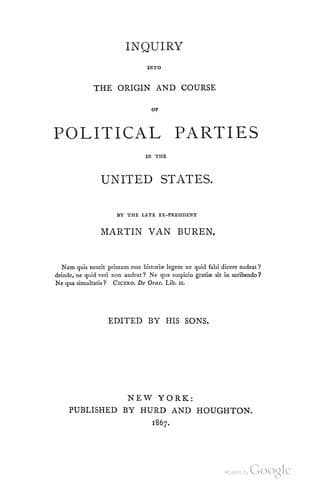
Inquiry Into the Origin and Course of Political Parties in the United StatesVan Buren, Martin
History
Inquiry Into the Origin and Course of Political Parties in the United States
Van Buren, Martin
Political parties -- United States
planters desire more than this are "the early and the latter rain," for
which they look to a source purer and more powerful than human
legislation.
Thus sustained, the Republican party of 1790, headed by Thomas
Jefferson, with the 'laboring oar' in the hands of James Madison, warmed
into action by Jefferson's more fervent though not more deeply seated
patriotism, and embracing "a great mass of talent," determined to oppose
every measure of Washington's administration which they believed to be
unauthorized by the Constitution, or anti-republican in its tendencies.
This resolution was carried out with unflinching firmness, but, whatever
has been said to the contrary, was made and designed to be performed in
a manner consistent with the respect they entertained for the character
and feelings of President Washington, and without even a desire to
displace him from the high office with which they had contributed to
invest him. It would have been strange if, in a state of party violence
so excited as that which naturally sprung up, the dominant party should
have refrained from aspersing the motives of their opponents by
attributing to them personal hostility to a chief so justly beloved by
the people as was Washington. Mr. Jefferson, in his letter to me,
referring to similar charges but speaking of a subsequent period, says
"General Washington, after the retirement of his first cabinet and the
composition of his second, entirely Federal, and at the head of which
was Mr. Pickering himself, had no opportunity of hearing both sides of
any question. His measures consequently took more the hue of the party
in whose hands he was. These measures were certainly not approved by the
Republicans; yet they were not imputed to him, but to the counselors
around him; and his prudence so far restrained their impassioned course
and bias that no act of strong mark during the remainder of his
administration excited much dissatisfaction. He lived too short a time
after, and too much withdrawn from information to correct the views into
which he had been deluded, and the continued assiduities of the party
drew him into the vortex of their intemperate career, separated him
still farther from his real friends, and excited him to actions and
expressions of dissatisfaction which grieved them but could not loosen
their affections from him."[25]
[25] See Appendix.
Public-domain text, read in full here on John Shaqi.
Reviews
Reviews
No reviews yet
Be the first to share your thoughts on this work.
Elsewhere in the archive
Join the Discussion
Join the discussion
Sign in to leave a comment or review.
Sign InorCreate an account