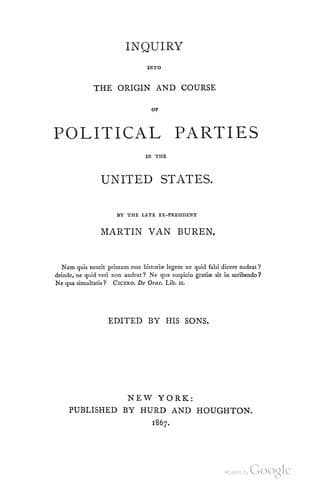
Inquiry Into the Origin and Course of Political Parties in the United StatesVan Buren, Martin
History
Inquiry Into the Origin and Course of Political Parties in the United States
Van Buren, Martin
Political parties -- United States
practicable, was, doubtless, from that time, within their contemplation.
That Revolution, which shattered, "past all surgery," the blasphemous
and absurd dogma of the divine right of kings; which replaced the
slavish doctrine of passive obedience and non-resistance with the
principle that the authority of the monarch was no other than a trust
founded on an assumed agreement between him and his subjects that the
power conferred upon him should be used for their advantage, for the
faithful execution of which he was individually responsible, and for a
breach of which resistance to his authority, as a last resort, was a
constitutional remedy; which for the supremacy of the Crown substituted
the supremacy of Parliament; which made the King as well as his subjects
responsible to its authority, and which abrogated the right of the Crown
to govern the colonies in virtue of its prerogative, and vested that
power in Parliament, placed the colonists upon a footing widely
different from that they had theretofore occupied.
The general principle that they were, by the laws and statutes of
England, entitled to the political rights that appertained to British
subjects, could not be denied, but commercial rivalry and political
jealousies acting upon their excited feelings, soon generated questions
of the gravest import, both as to the extent of the power of Parliament
to legislate for them, and as to the participation in representation
essential to authorize the exercise of that power.
The subjects of taxation and the regulation of trade by Parliamentary
authority, excited the greatest interest on both sides of the Atlantic.
In respect to the latter, the question was not a little embarrassed by
an alleged acquiescence on the part of the colonists, and the consequent
force of precedents. This circumstance, in connection with the
consideration that, if the right to regulate the trade of the colonies
was denied to the mother country, the allegiance conceded to be due
would be paid to a barren sceptre, was calculated to deprive the cause
of the colonists of the favorable opinion of those just men in England
whose countenance and support were of so much service to them in the
sequel. Duly appreciating the obstacles to success which there was
reason to apprehend from this source, with the prudence and good sense
that belonged to their character, and without waiving any of their
rights, they placed their cause principally upon a ground that lay at
the foundation of the Revolution, and was thoroughly immovable, viz.,
that by the fundamental laws of property no taxes could be levied upon
the people but by their own consent or that of their authorized agents,
and that by consequence the connection was indissoluble between taxation
and representation.
Public-domain text, read in full here on John Shaqi.
Reviews
Reviews
No reviews yet
Be the first to share your thoughts on this work.
Join the Discussion
Join the discussion
Sign in to leave a comment or review.
Sign InorCreate an account