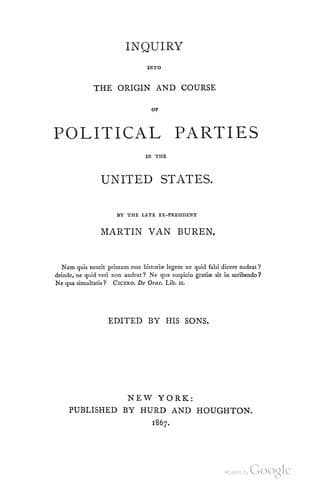
Inquiry Into the Origin and Course of Political Parties in the United StatesVan Buren, Martin
History
Inquiry Into the Origin and Course of Political Parties in the United States
Van Buren, Martin
Political parties -- United States
This proposition was met by a motion from Mr. Fisher Ames, of
Massachusetts, to rescind the vote of the 8th of June, and to refer the
business to a select committee. This motion gave rise to speeches
professing not to be opposed to the consideration of amendments at a
proper time and under proper circumstances, but showing a decided
distrust of and distaste for the whole proceeding. The motion prevailed
by a vote of 34 to 15, and a select committee was appointed, of which
Mr. Vining, an opponent, was made chairman. The report of this committee
contained substantially the amendments proposed by Mr. Madison, with
some alterations and additions. These, after revision by the House, were
finally passed by a vote of two thirds in both Houses, submitted to the
States and ratified by them, as they now appear as the first ten of the
twelve amendments that have been made to the Federal Constitution since
its first adoption.
Some of Mr. Madison's colleagues occasionally expressed a desire for the
success of his propositions, and similar avowals were sometimes made by
two or three members from other States; but of substantial, persevering,
and effective assistance, he may, with truth, be said to have had none,
and two thirds of the House were at heart decidedly opposed to the
amendments that were made. With all his talents, industry, and
perseverance, Mr. Madison would not have been able to carry them if his
exertions had not been seconded by an influence still more efficacious.
The legislature of Virginia alluded to the defects of the Constitution
as "involving all the great and inalienable rights of freemen," declared
that its objections were not founded on speculative theory, but deduced
from principles which had been established by the melancholy examples of
other nations in different ages, and said, "they will never be removed
until the cause shall cease to exist." It announced the "cause of
amendment as a common cause," and its trust that commendable zeal would
be shown by others also for obtaining those "provisions which experience
had taught them were necessary to secure from danger the inalienable
rights of human nature." It expressed its impatience of delay and its
doubt as to the disposition of Congress; complained of the slowness of
its forms, but congratulated itself on the possession of another remedy,
which it was determined to pursue, under the Constitution itself--that
of a convention of The States.
Public-domain text, read in full here on John Shaqi.
Reviews
Reviews
No reviews yet
Be the first to share your thoughts on this work.
Elsewhere in the archive
Join the Discussion
Join the discussion
Sign in to leave a comment or review.
Sign InorCreate an account