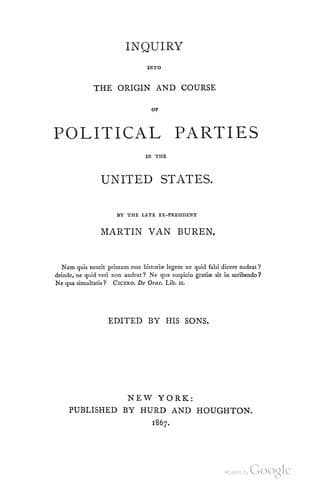
Inquiry Into the Origin and Course of Political Parties in the United StatesVan Buren, Martin
History
Inquiry Into the Origin and Course of Political Parties in the United States
Van Buren, Martin
Political parties -- United States
The New York application, signed, as Speaker, by John Lansing, Jr., who
had left the Federal Convention in consequence of his dissatisfaction
with its proceedings and never returned to it, though not going as much
into details, employed language equally bold and uncompromising in
demanding from Congress another convention, which might propose such
amendments "as it might find best calculated to promote our common
interests, and secure to ourselves and our latest posterity the great
and inalienable rights of mankind." This memorial asserted not only that
the New York Convention had ratified "in the fullest confidence of
obtaining a revision of the Constitution by a general convention, as
appeared on the face of its ratification," but that that body (of which
Hamilton was a member) were unanimous in the opinion that such a
revision was necessary to recommend that instrument to the approbation
and support of a numerous body of its constituents.
These documents, and especially that of Virginia, pointed very
emphatically to the source of that discontent with the Constitution
which so extensively prevailed in the old Anti-Federal ranks. Even they
felt that the Constitution was much better than they had expected, and
the most considerate among them, those who were most capable of
suspending their suspicions as to the designs of their opponents long
enough to give the instrument a dispassionate consideration, were soon
satisfied--and Samuel Adams, who stood at the head of the Anti-Federal
party, admitted--that its general structure was free from any
insuperable objection. The life-tenure given to the Federal Judges was,
as it indeed might well be, regarded as inconsistent with republican
principles; but it was to be remembered that those officers were
expected to be, as they ought always to be, non-combatants in partisan
politics by reason of their appointment to act as arbiters of the fates
and fortunes of their countrymen. Upon the great point to which the
attention of such men was first directed, that of the ability of the
State governments to maintain their sovereignty and independence under
the new system, there was no real ground for apprehension. But the
Constitution was principally confined to what were more strictly public
concerns, the powers and duties of the Federal and State Governments in
regard to National and State affairs, with only a slight sprinkling of
provisions looking particularly to the protection of the citizen against
the exercise of arbitrary power; and it was accompanied by no Bill of
Rights, such as those to which the people had been accustomed in respect
to their State governments. In the latter cases they might more readily
have been reconciled to the absence of such provisions, as those
governments were carried on under their immediate observation, and they
formed a part of them in much larger portions than they could expect to
do of the Federal Government. The latter they were too much in the habit
Public-domain text, read in full here on John Shaqi.
Reviews
Reviews
No reviews yet
Be the first to share your thoughts on this work.
Elsewhere in the archive
Join the Discussion
Join the discussion
Sign in to leave a comment or review.
Sign InorCreate an account