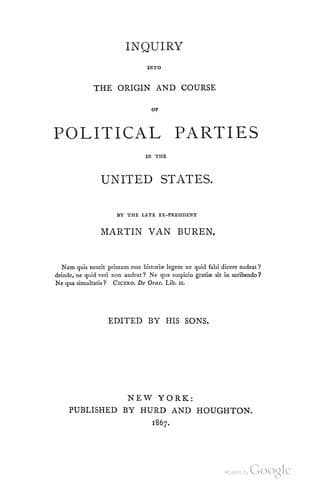
Inquiry Into the Origin and Course of Political Parties in the United StatesVan Buren, Martin
History
Inquiry Into the Origin and Course of Political Parties in the United States
Van Buren, Martin
Political parties -- United States
It was by adding this great service to those he had rendered in
obtaining the Convention, and in framing the Constitution in that body,
that he deservedly won the noble title of "Father of the Constitution."
He was neither as great a man nor as thorough a Republican, certainly
not as thorough a Democrat, as Mr. Jefferson; he had less genius than
Hamilton; yet it is doing him no more than justice to say that, as a
civilian, he succeeded in making himself more practically useful to his
country than any other man she has produced. No one would have been more
ready than Mr. Jefferson to award to Mr. Madison this high distinction.
He either told me at Monticello, or I heard it from him at second-hand,
(I am uncertain which was the case,) that whilst he was in France, some
one whom he named asked him to say whom he thought the greatest man in
America, and that he replied, if the gentleman would ask him to name the
greatest man in the world he would comply with the request, which
addition being made, he answered "James Madison!"
This brings us to the consideration of the contrast between the conduct
of Hamilton and Madison in respect to their treatment of a Constitution
which they had both taken such unwearied pains to bring into existence.
The course they respectively pursued upon the subjects of finance and
revenue, and the measures they respectively preferred, without regard to
questions of constitutional power, only indicated differences of opinion
upon subjects in which such differences are apt to arise, and did not
necessarily involve the political integrity of either. But we have now
arrived at a point of departure in the relative course of these great
men involving graver considerations, and to which it is to be regretted
that the last reservation cannot be truly applied. There was no warrant
in the Constitution for the establishment of a national bank, or for the
assumption of the State debts, or for the unlimited claim of power by
the Federal Government over the collection and disbursement of national
revenue, and for its patronage of by far the largest proportion of the
pursuits and interests of the country, all of which were effected by
Hamilton or recommended in his Report on Manufactures, and he understood
perfectly well that the Constitution conferred no such powers when he
advocated successfully the first two of those measures, and asserted the
power and recommended its exercise in respect to the latter.
Public-domain text, read in full here on John Shaqi.
Reviews
Reviews
No reviews yet
Be the first to share your thoughts on this work.
Elsewhere in the archive
Join the Discussion
Join the discussion
Sign in to leave a comment or review.
Sign InorCreate an account