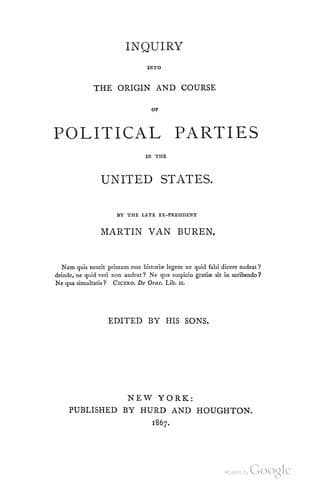
Inquiry Into the Origin and Course of Political Parties in the United StatesVan Buren, Martin
History
Inquiry Into the Origin and Course of Political Parties in the United States
Van Buren, Martin
Political parties -- United States
It is not agreeable to be obliged to assume that a gentleman of General
Hamilton's elevated character in private life, upon whose integrity and
fidelity in his personal dealings and in the discharge of every private
trust that was reposed in him no shadow rested, who was indifferent to
the accumulation of wealth, who as a public man was so free from
intrigues for personal advancement, and whose thoughts and acts in that
character were so constantly directed to great questions and great
interests, could yet prove faithless to one of the most sacred public
trusts that can be placed in man--the execution of the fundamental law
of the land. If Hamilton had been asked, as a private man, whether he
believed it was the intention of the framers of the Constitution to
confer upon Congress the power to establish a national bank, and whether
he believed that the people when they ratified it supposed that it
contained such a power, he would, if he answered at all, have answered
"No!" He was incapable of willful deception on the subject. This
discrepancy between his conduct as a statesman in the management of
public affairs and his integrity and truthfulness in private life was
the result of a vicious opinion as to the obligations of a public man,
and in no degree attributable to any inferior sense of personal honor,
nor was it ever otherwise regarded.
His position upon this point is understood to have been founded on the
following opinions: That the people as a body were not capable of
managing their public affairs with safety to their happiness and
welfare; that it was, therefore, a proper exercise of power to give the
management of them into the hands of those who were capable, and to
place the latter in positions, as far as practicable under the
circumstances, beyond popular control; that it was the sacred duty of
those who were so intrusted to exercise their power truly and sincerely
for the best interests of those for whom they acted; that if those
interests could be well administered without transcending the power with
which the public functionary was invested, or without the practice of
deception or corruption, such would be the preferable and proper course;
but if violations of the popular will, deception, or corruptions--not
those of the grosser kind, like direct bribery, but such as belonged to
the class he spoke of to Mr. Adams as constituting the life-giving
principle of the English system--were necessary, in the best judgment of
men in power, to the security or advancement of the public welfare, the
employment of such means was justifiable.
Without stopping to cite authorities, I assume--on the strength of the
opinion of the age in which he lived, of his writings, of his
declarations, which were, beyond almost all other public men, without
reserve, and of his acts--that such were his views, and content myself
with the declaration that the existence of such views is the best, if
not the only, excuse that can be made for his official course.
Public-domain text, read in full here on John Shaqi.
Reviews
Reviews
No reviews yet
Be the first to share your thoughts on this work.
Elsewhere in the archive
Join the Discussion
Join the discussion
Sign in to leave a comment or review.
Sign InorCreate an account