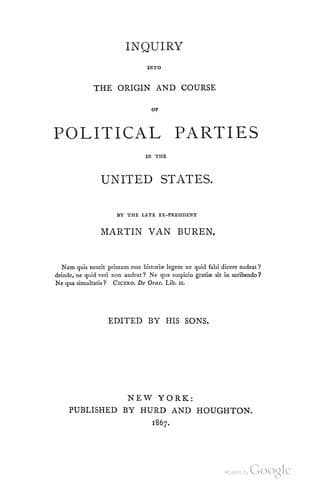
Inquiry Into the Origin and Course of Political Parties in the United StatesVan Buren, Martin
History
Inquiry Into the Origin and Course of Political Parties in the United States
Van Buren, Martin
Political parties -- United States
At the close of the Convention, and just before signing the
Constitution, he declared that the latter might serve as a temporary
bond of union, but could never suffice to secure good government. After
he had succeeded in his first two interpolations, he spoke exultingly of
the success of the Constitution, and hopefully of the future; this was
because he knew that he had prospered in his attempt to give it a
construction not dreamed of at the former period by himself, or others
to his knowledge; and his hopes of the future were founded on his
success also in his plan set forth in his Report on Manufactures,
widening very greatly the breach he had already effected in the
Constitution. In February, 1802, after his latitudinarian scheme had
been arrested and was in danger of being permanently overthrown, he
described the Constitution to Gouverneur Morris as a "frail and
worthless fabric," the "fate" of which he had "anticipated from the very
beginning." He never reproached his friends with an unwillingness to go
as far as the Constitution would justify, but always attributed their
failure to defects in the system, thus admitting that the measures in
which he exulted and from which he hoped so much, had been established
by him, not under, but outside of that instrument.
The first marked effect of Hamilton's determination to pursue the course
I have described was a separation between him and his most efficient
coadjutor upon many points during the government of the Confederation,
and the next was the formation of the old Republican party. The motives
for the separation between those distinguished associates have been made
the subject, as might have been expected, of various and extensive
comment. So far as I know, Hamilton never spoke of Madison, after their
separation, in any other terms than those which were consistent with the
knowledge he possessed of the purity and integrity of his character. Few
men had such perfect control over their feelings as Mr. Madison, and few
exercised more reserve in speaking of the motives of his political
opponents. It has been rare indeed that he has ventured to touch upon
them even when necessary to his vindication from aspersions upon his own
character, a truth obvious to any one familiar with his life and
writings. I however accidentally came into the possession of
information upon this precise question of very great interest, which
will be found in the letter below from Nicholas P. Trist, Esq. In the
course of a conversation between Mr. Trist, myself, and other gentlemen,
at Philadelphia, last spring,[26] upon the subject of which they had
only a general bearing, the former alluded to the circumstances here
given in detail, and subsequently, at my request, reduced them to the
shape in which they now appear.
[26] In the spring of 1857. Eds.
Public-domain text, read in full here on John Shaqi.
Reviews
Reviews
No reviews yet
Be the first to share your thoughts on this work.
Elsewhere in the archive
Join the Discussion
Join the discussion
Sign in to leave a comment or review.
Sign InorCreate an account