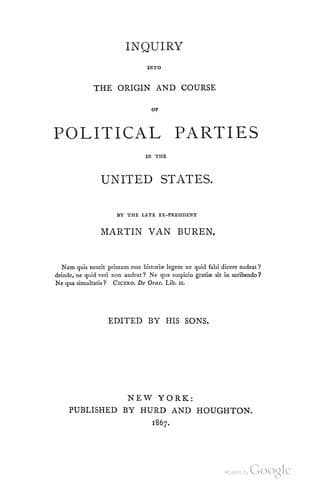
Inquiry Into the Origin and Course of Political Parties in the United StatesVan Buren, Martin
History
Inquiry Into the Origin and Course of Political Parties in the United States
Van Buren, Martin
Political parties -- United States
In the contest for the Constitution that party was also throughout more
useful than its opponents. In this estimate the course taken by Hamilton
is not regarded as the act of his party, except as to that portion of it
which consisted in signing the Constitution and in aiding its adoption.
The issues involved in the fourth decisive crisis in our political
fortunes were contested during the presidency of John Adams. The whole
of that administration was a political campaign, occupied by bitter and
uninterrupted struggles for predominance between the conflicting
principles of two great parties. The most important, although perhaps
not the most exciting, of the questions and measures in dispute had
arisen during the administration of President Washington; but his
presence and participation in the Government held the parties at bay.
Political alienations had then taken place, and wounds had been
inflicted which were never healed, and bitter fountains sprang up and
struggled for an outlet, but they were in a great degree restrained by
that consideration. The leading men among those who soon after
organized the first Republican, now called the old Republican, party,
made it a point to abstain from violent action, and to content
themselves with protests against measures of which they disapproved, but
which they could not defeat. Jefferson gave his opinion in the cabinet,
and Madison made his unanswerable speech in the Congress against the
bank, and the latter, with other Republicans, spoke strongly against
particular features of the funding system, but both measures were
nevertheless adopted by decisive majorities; and still, as far as
practicable, harsh invective and reproaches against those majorities
were withheld or delayed. The removal of the salient point of attack, by
the withdrawal of Hamilton from the cabinet, served also to stay
partisan outbreaks on the part of the Republicans, who were, throughout,
not unmindful of the advantages they would give to their opponents by
bringing matters to a crisis whilst Washington was at the head of the
Government. On the other hand, Hamilton evidently was discouraged by the
restrictions imposed upon him by the prudence of Washington. It is
apparent that, although by far more confided in, on the score of his
great talents, than any other member of the administration, he was yet
not allowed the latitude which he thought necessary to success. No one
can read his remarkable letter to Washington (to which I have referred
in another connection) without perceiving that he was seriously
discontented. He thought that there were men about the President who
interfered with and opposed his counsels, and he avowed his suspicions
to that effect in that letter to Washington, with the expression of a
hope that the latter would one day understand those men better. There
was, besides, as Jefferson admits, "no act of strong mark during the
remainder of his" (Washington's) "administration that excited much
complaint."
Public-domain text, read in full here on John Shaqi.
Reviews
Reviews
No reviews yet
Be the first to share your thoughts on this work.
Elsewhere in the archive
Join the Discussion
Join the discussion
Sign in to leave a comment or review.
Sign InorCreate an account