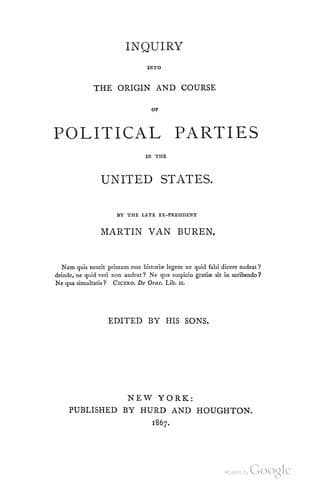
Inquiry Into the Origin and Course of Political Parties in the United StatesVan Buren, Martin
History
Inquiry Into the Origin and Course of Political Parties in the United States
Van Buren, Martin
Political parties -- United States
Discontents were, therefore, in a great degree, held in abeyance waiting
the succession for more active resistance and redress. The arrival of
that period--the retirement of Washington and the election of
Adams--found the field clear for the great contest for which the
materials had been gathered and the hearts of the combatants prepared.
Mr. Jefferson endeavored, as far as was proper, to prevent himself from
being regarded as a competitor with Mr. Adams, when the latter was
elected. He wrote to Mr. Madison, requesting him to withdraw his name if
there should be an equality of votes between himself and Mr. Adams,
which was not an improbable result, assigning, as a reason, that the
latter was greatly his senior in years, and had always stood in advance
of him in public life. But notwithstanding the friendly feelings that
had existed between them down to that period, their relations soon
assumed a very decided character of political opposition. Then commenced
that fierce partisan struggle which has never been equaled here and
seldom, if ever, in any country, either in respect to the gravity and
interest of the principles involved, or to the ability and firmness with
which the ground of the respective parties was sustained.
A full account of the incidents of this four years' controversy would
carry this work far beyond the limits of my plan and of my time. My
object has been to trace the origin and first organization of our
political parties. To this full notices of the early measures out of
which they sprang were indispensable. Partisan conflicts upon questions
that arose after their organization was completed, are to be regarded as
effects rather than as causes of their existence. The spirit which
controls the action of sects and parties, in church or state, is indeed
selfish and perverse, becoming more and more characterized by those
qualities the longer they are kept on foot. When a new measure is
proposed, or doctrine announced, on either side, the problem presenting
itself for deliberation _eo instanti_ to the minds of the opposite
faction, is as to the degree of strength and credit which its
introduction and success may be expected to bring to its authors, and of
consequent damage to their own party,--degrees, of course, dependent
upon the extent of its probable advantage to the interests of religion,
in one case, or of the country, in the other,--and in such deliberation
the claims of religion and country are in great danger of being
postponed for the interests of parties, and the new doctrine or measure
of meeting with a resistance proportioned to its probable merit. It
results as a general rule that it is sufficient to induce one party to
oppose any given measure to know that it has been introduced by its
adversary. This is an unfavorable and humiliating view of a subject
which nevertheless includes great advantages in a free State, but its
truth is unhappily too obvious.
Public-domain text, read in full here on John Shaqi.
Reviews
Reviews
No reviews yet
Be the first to share your thoughts on this work.
Elsewhere in the archive
Join the Discussion
Join the discussion
Sign in to leave a comment or review.
Sign InorCreate an account