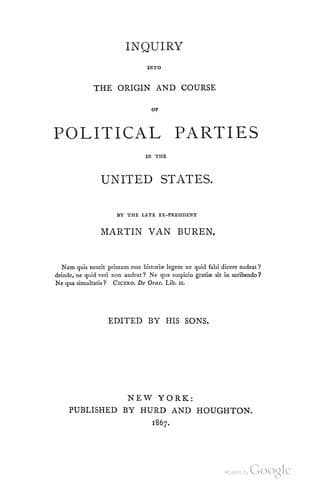
Inquiry Into the Origin and Course of Political Parties in the United StatesVan Buren, Martin
History
Inquiry Into the Origin and Course of Political Parties in the United States
Van Buren, Martin
Political parties -- United States
years, after wading through the volumes of political and personal
detraction which have been written against him, to read for the first
time vindications authentic, simple, and conclusive without being
sometimes betrayed into expressions which would not have been indulged
at moments of less excitement.
Occasional mistakes in a work of such extent, even with the best
intentions, and with what may well be regarded as the most reliable
sources of information, are still unavoidable. I have elsewhere
corrected a very important one in respect to Mr. Madison's vote on
Giles's resolution censuring the conduct of Hamilton. I dissent also
from the inferences drawn in a few instances from facts about which
there is no mistake,--such as Washington's intentions respecting the
rank of the major-generals for the provisional army, and the blame
imputed to Jefferson and Madison,--to the latter for not accepting the
office of Secretary of State when the former resigned, and to Jefferson
for declining Washington's invitation to return to it; but I have not
seen any statement in the whole work which I do not believe was intended
to be correct, or any construction of ascertained results which does not
appear to have been made in good faith.
It is conceded on all sides that Hamilton and Jefferson, during the
presidency of John Adams, were the leaders of the two great parties--the
substantial amalgamation of the old Anti-Federal and Republican parties
leaving but two. Hamilton's position was unprecedented. Although the
President and himself were, almost from the commencement of the
campaign, upon very bad terms--feeling strong personal dislike towards
each other, and holding no really friendly intercourse--he
notwithstanding directed the course of the administration, and
controlled the entire action of the Government to a greater extent than
he had done at any time during the presidency of Washington. These
extraordinary results he accomplished by means of the complete
ascendancy, to which I have heretofore alluded, which he possessed over
the three principal members of Mr. Adams's cabinet,--Pickering, Wolcott
and McHenry,--and by the peculiar influence that he was capable of
exerting over the Federal members of Congress. I have referred to
letters, state papers, briefs, and instructions for the action of those
parties establishing the truth of this position. With very limited
exceptions the control of Mr. Adams over his own administration was
little more than nominal. He served the purpose, and that was his chief
burden, of bearing the responsibility of unpopular measures--a fortunate
circumstance for the Republicans, as he excelled most men in his
capacity for adding to the odium of an obnoxious measure by the manner
of executing it.
Public-domain text, read in full here on John Shaqi.
Reviews
Reviews
No reviews yet
Be the first to share your thoughts on this work.
Elsewhere in the archive
Join the Discussion
Join the discussion
Sign in to leave a comment or review.
Sign InorCreate an account