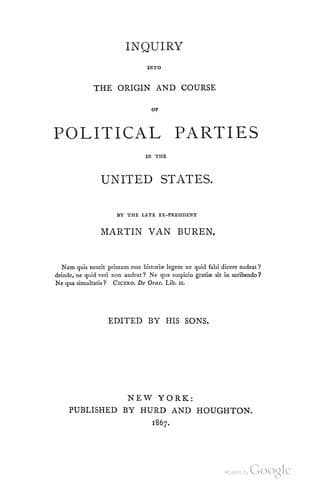
Inquiry Into the Origin and Course of Political Parties in the United StatesVan Buren, Martin
History
Inquiry Into the Origin and Course of Political Parties in the United States
Van Buren, Martin
Political parties -- United States
I doubt whether, in the history of the world, another occasion can be
found when any two men were as successful as were Jefferson and Hamilton
in impressing such great numbers of intelligent people with their own
opinions and views upon the subjects of government and its proper
administration.
Acts and avowed opinions speak for themselves, but to determine the
motives of parties in the adoption of their measures no safer tests
perhaps can be employed than the characters and dispositions of those by
whom the parties themselves were founded and, in their early stages,
guided. Hamilton's character, qualifications, and views have already
occupied a large space in these pages. If they have been spoken of in
any other than a faithful and liberal spirit, I have certainly failed
to do justice to my own feelings. Of Thomas Jefferson, the founder as
well as leader of the old Republican, now Democratic, party,
comparatively little has been said. Opposed as they were in their
opinions upon almost every public question that arose after the adoption
of the Federal Constitution, there were yet occasional coincidences of
sentiment which served to illustrate the elevated character of their
minds, as there were also many features of their respective careers
which, while broadly contrasted, furnished the strongest evidence of the
sincerity and integrity of both. Not the least striking among the latter
may be found in the circumstances and conditions of life in which they
respectively started in the "race set before them," as connected with
the ideas and opinions at which they arrived, so variant from those
commonly impressed upon men by similar accidents.
Descended from a highly honored stock, it was yet Hamilton's lot to be
born poor and to be left solely dependent upon his own exertions for his
success in life. After a service of three years as clerk in a
counting-house he was sent to this country for the completion of his
education, at the expense of relatives on his mother's side. Here he
made himself acquainted with the character of our dispute with the
mother country, and took sides with the colonists in a manner and under
circumstances highly creditable to him, and after five years' military
service, in which he acquired great reputation in comparatively
subordinate stations, he retired to private life, adopting the legal
profession as his only resource for the support of his family.
Public-domain text, read in full here on John Shaqi.
Reviews
Reviews
No reviews yet
Be the first to share your thoughts on this work.
Elsewhere in the archive
Join the Discussion
Join the discussion
Sign in to leave a comment or review.
Sign InorCreate an account