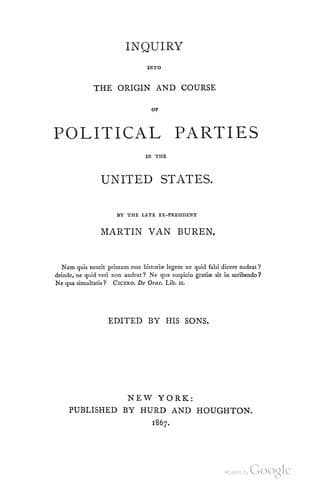
Inquiry Into the Origin and Course of Political Parties in the United StatesVan Buren, Martin
History
Inquiry Into the Origin and Course of Political Parties in the United States
Van Buren, Martin
Political parties -- United States
At the age of twenty-two--a period in Hamilton's life when his already
teeming mind was meditating the establishment of institutions, and the
adoption of measures to strengthen the Government, and to enable it to
exercise what he deemed a salutary and necessary restraint upon the
popular will, institutions and measures in the working of which, from
their nature, none but moneyed men could be expected to
participate--Jefferson was as actively and constantly employed in the
Virginia House of Delegates, in concert with the earliest Revolutionary
patriots of that State, in preparing her, as well as the hearts of the
people, for the great movement then already the subject of confident
anticipation with minds like theirs. There he remained until 1775, when
he was appointed a delegate to the Continental Congress. Of his agency,
whilst a member of that body, in preparing the Declaration of
Independence, and in promoting its adoption, it is unnecessary here to
speak. As soon as that noble work had been accomplished, he resigned his
seat, accepted a reëlection to the State Legislature as the position in
which, though less exalted, he could render more useful services to the
cause, and the measures to which his exertions were there directed were
in harmony with the spirit of the Revolution, and designed, as avowed by
himself, "to eradicate every fibre of ancient or future aristocracy, and
to lay a foundation for a government truly republican." The results of
the joint labors of himself and his patriotic associates were:
1st. An act to prevent the further importation of slaves, a practice
which he had denounced in the Declaration of Independence as a
"piratical warfare, the opprobrium of infidel powers;"
2d. An act to abolish entailments;
3d. An act to abolish primogenitureship--a right which had vested in
himself;
4th. An act for religious freedom; and
5th. A bill for general education.
These were not only appropriate but indispensable steps to lay a sure
foundation for republican government, State as well as National. Most,
if not all of the States, followed her lead, but to Virginia belongs the
high merit of having been in this respect the first in the field, and to
Jefferson a large share of that merit.
Public-domain text, read in full here on John Shaqi.
Reviews
Reviews
No reviews yet
Be the first to share your thoughts on this work.
Elsewhere in the archive
Join the Discussion
Join the discussion
Sign in to leave a comment or review.
Sign InorCreate an account